How the Strategic Diagnostic Engine Works
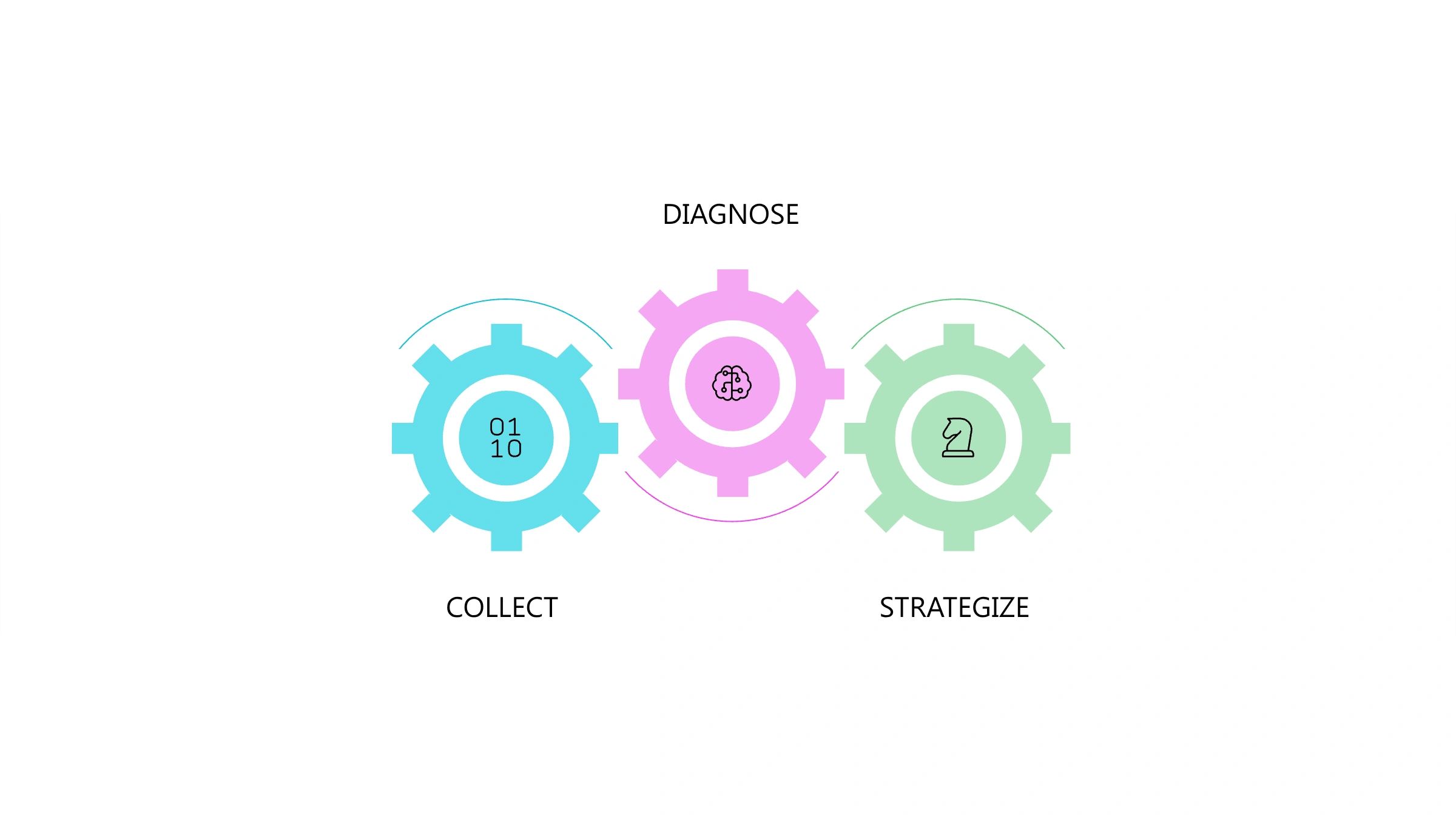
The Strategic Diagnostic Engine™ is the analytical backbone of the Intelligent Workplace™ system. It converts organisational complexity into structured, decision-grade intelligence through a three-phase process: Collect, Diagnose, Strategize. The engine does not produce reports. It produces outputs that organisations can act on immediately. It is the mechanism that transforms the Intelligent Workplace™ from a conceptual architecture into a functioning management system, and it is the most consequential layer that most enterprise transformation programmes never see.
The Pattern Most Organisations Cannot See in Themselves
Walk into any enterprise that has invested seriously in workplace transformation and you will find something predictable. There is a framework on the wall, or in a deck, or cited in a quarterly review. There are maturity scores. There are recommendations. And the organisation is largely where it was two years ago.
Not because the framework was wrong. Not because the leaders were unwilling. But because something essential was missing between the assessment and the action. Something that should have told the organisation not just where it stood, but why it stood there, and which specific constraint, resolved in which sequence, would actually move it forward.
Most enterprise organisations have invested in workplace assessment. Very few have invested in workplace diagnosis. The difference is not semantic. It is structural. And it is where most transformation programmes quietly fail.
Most organisations sense that their workplace is underperforming. Very few can explain why with confidence. The same tools, policies and investments produce very different results across teams, offices, regions and partners. That is a visibility problem before it is anything else.
Measurement without causality is navigation without a map
The majority of maturity frameworks operating in the enterprise market today are classificatory systems. They answer a limited set of questions with considerable sophistication: What level are we at? How do we compare to peers? What does the next level look like? These are useful questions. The problem is what they leave unanswered.
Knowing that your Workflow dimension is at maturity level 2 does not tell you whether that score is caused by unclear decision rights, insufficient governance architecture, weak automation capability, or a leadership team that resolves ambiguity through consensus rather than structure. Each of those causes requires a different intervention. Each has a different sequencing dependency. Applying the wrong intervention with confidence does not accelerate transformation. It delays it.
This is the fundamental limitation of assessment without diagnosis. The system measures state. It does not model causality. And in complex organisations, state measurement without causal structure produces something more dangerous than ignorance: it produces confident action in the wrong direction.
There is a further failure mode that receives almost no attention. Organisations that deploy AI into this environment compound the problem at speed. AI amplifies what already exists. If the workflow structure is fragmented, AI-enabled workflows fragment faster. If governance integrity is weak, AI-accelerated decisions erode it more efficiently. The operating model must precede the technology. Measurement alone cannot sequence that transition.
What the Strategic Diagnostic Engine Actually Does
The Strategic Diagnostic Engine™ was designed to close exactly this gap. It is not a scoring tool dressed in a more compelling name. It is a fundamentally different class of management instrument.
The engine operates through three sequential phases.
- The first phase is Collect. This is evidence-based data gathering across the four dimensions of the relevant pillar framework. In the case of enterprise workplace assessment, it refers to the 4W Workplace Framework™ dimensions of Workforce, Workflow, Workspace, and WorkTech. Evidence collection is multi-stakeholder and structured. The instrument is diagnostic, not a survey. What distinguishes this phase is the requirement that advancement requires evidence, not assertion. An organisation cannot self-score its way to a higher maturity level. The evidence must support the position.
- The second phase is Diagnose. This is where the engine separates from standard maturity assessment. The 5x4 Question Model applies twenty structured questions (five per dimension) scored on a 1-5 maturity scale with evidence required for advancement at each level. The analytical processing that follows does not simply aggregate scores. It identifies patterns, misalignments, and structural gaps across dimensions. It reveals where one dimension is constraining the performance of others, because in the 4W Workplace Framework™, fragmentation in one dimension constrains performance across all four. A Workforce operating at maturity level 4 cannot realise its potential inside Workflows operating at level 2. The diagnostic layer surfaces that asymmetry and identifies its structural cause.
- The third phase is Strategize. This is where intelligence becomes action architecture. The output is not a recommendation list. It is a sequenced transformation roadmap - with priorities mapped across 0 to 90 days, 3 to 6 months, and 6 to 24 months - calibrated to where the organisation is, what is constraining it, and what the evidence supports as the highest-leverage intervention. The sequence matters as much as the content. Organisations that execute the right interventions in the wrong order produce poor outcomes. The Strategize phase is designed to prevent that.
The engine is framework-agnostic. It does not define workplace dimensions itself, it does not replace strategy, and it does not prescribe solutions. It provides a standardised diagnostic logic, evidence-based scoring and consistent outputs, applied through role-specific frameworks such as the 4W Workplace Framework for enterprises. AI does not correct broken systems. It exposes them.
Eight Outputs. One Architecture. No Guessing.
The engine produces eight structured output types, calibrated to engagement tier.
- The Alignment Radar provides an immediate visual maturity map across all four dimensions of the relevant framework.
- The Maturity Index delivers a consolidated maturity score.
- The Strategic Position Matrix locates the organisation relative to the transformation curve.
- The Structural Gap Analysis identifies critical misalignments and capability gaps.
- The Value Impact Map connects maturity scores to business outcomes - productivity, decision quality, collaboration, and innovation.
- The Risk and Resilience Profile surfaces structural risks and governance vulnerabilities.
- The Benchmark Report provides comparative positioning against peer and industry data. The Transformation Roadmap sequences strategic priorities from current state to the next maturity stage.
What matters about this output architecture is not the number of outputs. It is what they collectively enable. An organisation leaving an engagement with these eight structured intelligence artefacts does not have a report. It has a decision layer. It knows where it is, why it is there, what it is risking by remaining there, how it compares to the field, and what it should do in what sequence to move.
That is the difference between a management instrument and a consulting deliverable.
The Precondition No Framework Can Provide
Here is the part that frameworks almost never address, and the part that determines whether the intelligence produced by any diagnostic engine is ever acted on.
A framework gives an organisation the grammar for constructing a shared understanding of its current state. A diagnostic engine produces the intelligence. But neither of those things determines whether the leadership team can reason together about what that intelligence requires of them.
Organisational intelligence is not a property of a framework. It is not even a property of the diagnostic outputs that framework produces. It is a property of the institution's ability to sustain structured disagreement about what those outputs mean long enough for the right action to emerge.
This is not a soft observation about culture or psychological safety. It is an architectural requirement. Suppressed disagreement about diagnostic findings produces false coherence. A leadership team that converges quickly on an interpretation of a Structural Gap Analysis has not demonstrated intelligence. It has demonstrated consensus. Those are not the same thing, and they frequently point in different directions.
The Strategic Diagnostic Engine™ is designed to surface the right questions precisely because structured questions reduce the degrees of freedom in acceptable answers. The 5x4 Question Model does not ask whether an organisation has AI tools. It asks whether Workflow decisions are constrained by governance policies. It asks whether technology adoption correlates with capability development. It asks where knowledge loss occurs when people leave. These are not presence indicators. They are dependency indicators; questions designed to reveal the relationships between dimensions, not merely confirm their existence.
That question architecture only produces value if the leadership team engaging with it is capable of genuine interrogation. The framework provides the instrument. The institution must provide the capacity to use it honestly.
What This Means for How You Lead Transformation
For the executive leading a workplace transformation programme, the implication is specific.
If your current approach produces maturity scores without a causal layer, without an explanation of why each dimension is at the level it is and which structural condition is the binding constraint, you are navigating with a compass but no map. You know which direction is north. You do not know what is between you and the destination.
If your diagnostic process does not require evidence for advancement, you are measuring self-perception, not structural maturity. The gap between those two is where transformation programmes disappear.
If your transformation roadmap does not sequence interventions by causal dependency, if it lists priorities without specifying which must precede which and why, you are executing in a sequence that may be coherent on paper and counterproductive in practice.
And if your leadership team converges on diagnostic findings without structured challenge, if the Structural Gap Analysis produces agreement rather than interrogation, the intelligence has been processed but not used.
The Strategic Diagnostic Engine™ is the mechanism that addresses the first three of those gaps. The fourth is an institutional capacity that precedes everything else.
The framework gives you the map. Your organisation's ability to reason together under structured disagreement about what that map reveals determines whether you can use it.
The Framework Is the Beginning, Not the Answer
The Intelligent Workplace™ is an enterprise operating model that aligns Workforce, Workflow, Workspace, and WorkTech into a unified, AI-enabled system. It is the target architecture. The 4W Workplace Framework™ is the diagnostic instrument that measures maturity against that target. The Strategic Diagnostic Engine™ is the mechanism that converts that measurement into decision-grade intelligence.
Three layers. Distinct roles. None of them sufficient alone.
Organisations that invest in the framework without the engine produce assessments. Organisations that engage the engine without the institutional capacity to act on its outputs produce intelligence that enters a governance process and stalls. Organisations that build all three, structural model, diagnostic mechanism, and the leadership capacity for structured disagreement, produce transformation.
Organisational intelligence does not begin with the framework. It begins before it, in the decision to engage with diagnosis rather than measurement, causality rather than classification, and structured disagreement rather than confident consensus.
The engine is the instrument. What your organisation does when it produces an uncomfortable finding is the test.
To explore further, visit:
- The Intelligent Workplace
- The 4W Workplace Framework
- The Strategic Diagnostic Engine
- 4W Framework vs Intelligent Workplace Explained
Frequently asked questions
What is the Strategic Diagnostic Engine?
The Strategic Diagnostic Engine is the analytical backbone of the Intelligent Workplace system. It converts organisational complexity into structured, decision-grade intelligence through a three-phase process: Collect, Diagnose, Strategize.
How does it differ from a maturity framework?
Most maturity frameworks classify: what level are we at, how do we compare to peers. The engine adds causality: why each dimension sits where it does, and which structural condition is the binding constraint.
What does the Strategic Diagnostic Engine produce?
Eight structured output types calibrated to engagement tier, including the Alignment Radar, a visual maturity map across all four dimensions, and the Maturity Index, a consolidated maturity score.
Does the engine replace strategy?
No. It is framework-agnostic: it does not define workplace dimensions, replace strategy or prescribe solutions. It supplies a standardised diagnostic logic, evidence-based scoring and consistent outputs through role-specific frameworks.
How do the Intelligent Workplace, the 4W Workplace Framework and the engine fit together?
The Intelligent Workplace is the target operating model. The 4W Workplace Framework is the diagnostic instrument that measures maturity against it. The Strategic Diagnostic Engine is the mechanism that produces the intelligence.
Comments
Post a Comment