What Is AI Workflow Integration?
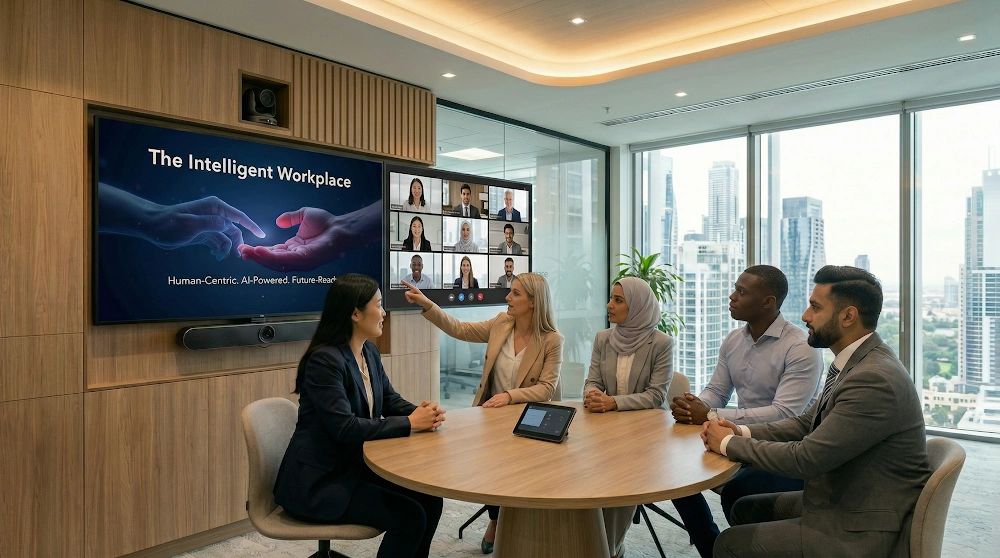
What is AI workflow integration?
AI workflow integration is the deliberate restructuring of how work is sequenced, decided, and executed in response to artificial intelligence capability, as distinct from simply adding AI tools to existing processes. It is a foundational dimension of the Intelligent Workplace, where organisational performance depends on whether AI is embedded into the logic of work or layered on top of it. Without workflow integration, AI investment produces new subscriptions rather than structural change.
Why AI adoption stalls at the access question
Most organisations pursuing AI adoption are solving the wrong problem. They are focused on access: which tools to license, which teams to train, which vendors to partner with. These are legitimate procurement questions, but they are not transformation questions. The organisations that answer them well end up with capable tools sitting alongside unchanged processes. The capability is present. The change is not.
This is where AI investment quietly stalls. People learn to use AI within the logic of existing work rather than using AI to redesign the logic itself. The result looks like adoption. It is not transformation.
Layering versus integration
The gap is not technological. It is structural. When an intelligent tool is placed into an unintelligent workflow, the workflow wins. It absorbs the tool, routes around its potential, and continues producing the same outputs through slightly different means.
The diagnosis is consistent across industries and organisational types. AI is being layered onto workflow rather than integrated into it. The distinction matters enormously. Layering adds a step, a tool, a prompt. Integration changes how work is sequenced, how decisions are made, where human judgment is applied, and what outputs are expected. One approach produces marginal efficiency. The other produces structural change.
Many enterprise workflows are built around constraints that no longer exist, around legacy systems since replaced, around approval chains designed for a different risk environment. AI does not simply accelerate these workflows. It exposes them.
How the 4W Workplace Framework treats Workflow
This is precisely why the 4W Workplace Framework treats Workflow as a foundational dimension, not a downstream consideration. Workflow is not the delivery mechanism for strategy. It is where strategy either becomes real or dissolves into aspiration. If the way work moves through an organisation does not change, the strategy has not landed. The AI investment has not landed.
The Workflow dimension asks organisations to examine something most leadership teams find genuinely uncomfortable: not what tools their people are using, but how work is actually structured at the level of tasks, decisions, handoffs, and outputs. This examination requires honesty about process, and that honesty is the precondition for meaningful AI integration.
The Human-AI Intelligence Charter reinforces this principle by establishing that the most consequential decisions in AI deployment are not configuration choices. They are governance choices: who touches which decisions, at what point human judgment enters, and who is accountable for the quality of outputs from a redesigned workflow.
Organisations that are genuinely progressing with AI transformation share a visible characteristic. They treat workflow redesign as a precondition, not a consequence. They do not ask how AI can fit into what they already do. They ask what they should be doing differently, and then determine where AI enables that difference.
Why workflow redesign belongs on the executive agenda
Workflow redesign is not a project for operations or IT to manage in isolation. It is a strategic responsibility because the decisions made at the workflow level determine what AI actually does inside an organisation. These are not configuration questions. They are leadership questions, and they belong on the executive agenda.
There is also a sequencing issue that many organisations are navigating backwards. The instinct is to adopt AI and then figure out what changes. The more productive sequence is to examine the workflow first, identify where the genuine constraints and friction points are, and then deploy AI in deliberate response to those findings. This is not about slowing down. It is about deploying with intention rather than optimism.
For executives who are uncertain where their organisation currently stands, the Strategic Diagnostic Engine provides a structured starting point, mapping workflow readiness alongside the other dimensions of intelligent workplace performance.
The question every AI programme should answer
The technology is not the obstacle, and it rarely has been. The question worth sitting with is this: in your organisation, is AI being asked to accelerate existing work, or to redesign what work looks like altogether?
The answer to that question determines whether your AI investment produces transformation or, simply, a new subscription.
Frequently asked questions
What is AI workflow integration?
AI workflow integration is the deliberate restructuring of how work is sequenced, decided, and executed in response to artificial intelligence capability, as distinct from simply adding AI tools to existing processes.
What is the difference between layering AI and integrating it?
Layering adds a step, a tool or a prompt to an existing workflow. Integration changes how work is sequenced, how decisions are made, where human judgment is applied, and what outputs are expected.
Why do AI investments stall?
Organisations focus on access: which tools to license, which teams to train, which vendors to partner with. They end up with capable tools alongside unchanged processes, and the existing workflow absorbs the tool.
Who should own workflow redesign?
Executive leadership. Decisions made at the workflow level determine what AI actually does inside an organisation, so redesign is a strategic responsibility rather than a project for operations or IT alone.
Where should an organisation start?
Examine the workflow first, identify the genuine constraints and friction points, then deploy AI in deliberate response to those findings. The Strategic Diagnostic Engine maps workflow readiness alongside the other dimensions of intelligent workplace performance.
This analysis is part of The Intelligent Workplace newsletter, a weekly briefing for executives and workplace consultants on AI strategy and organisational performance. Subscribe at intelligentworkplace.ai.
Comments
Post a Comment