Integrate 2026: The Intelligent Workplace Delivery Gap
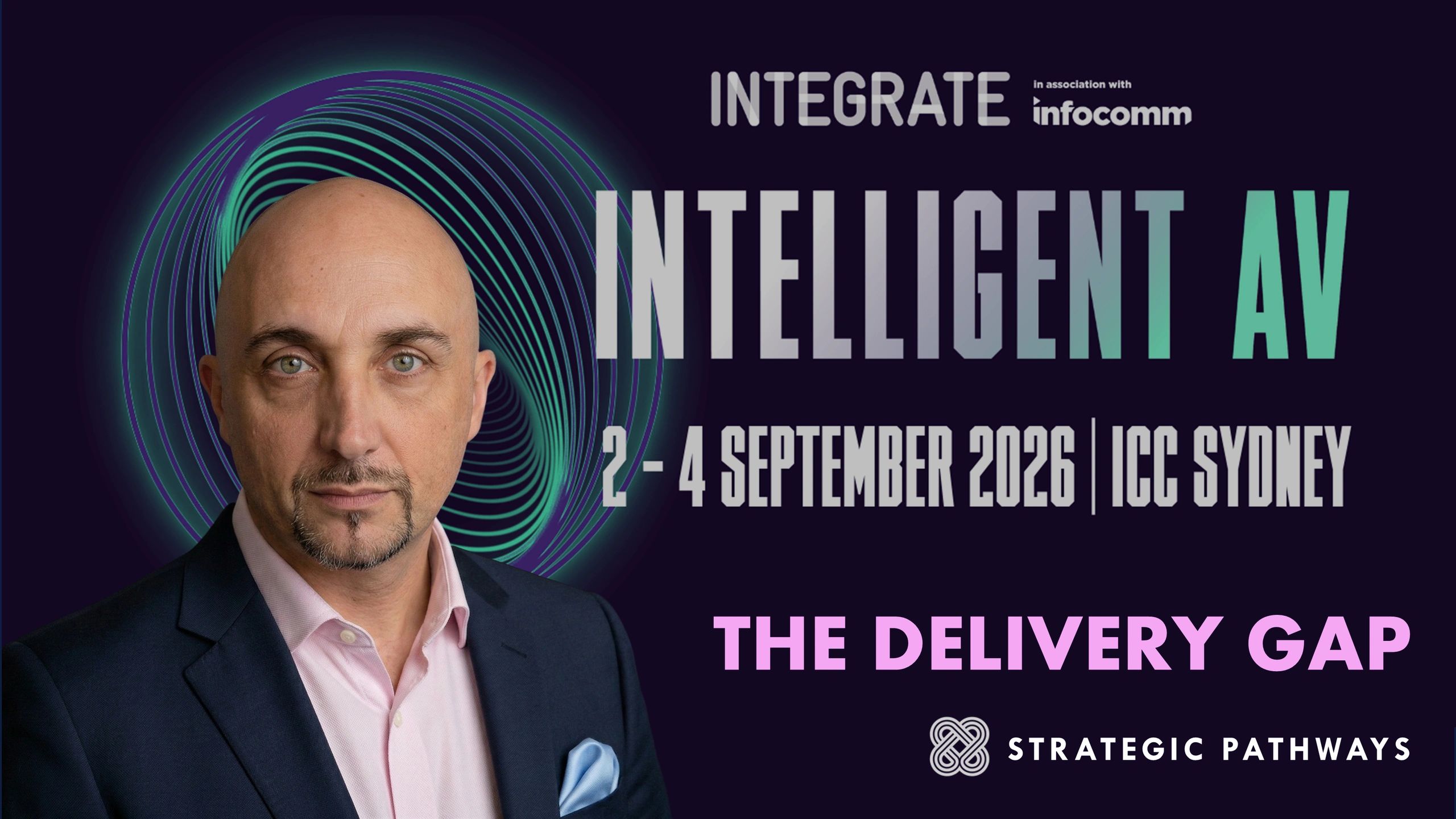
The Intelligent Workplace delivery gap is the distance between an enterprise that has started buying workplace outcomes and a supply chain still organised to install workplace equipment. Integrate 2026 in Sydney told buyers to stop specifying hardware. It left open the question of who is qualified to deliver what replaces it.
The Intelligent Workplace™ is an enterprise operating model that aligns four structural dimensions, Workforce, Workflow, Workspace and WorkTech, into a unified, AI-enabled system designed to enable consistent organisational performance, decision quality, collaboration, and innovation at scale.
It is a structural gap rather than a commercial one. It does not close with better products, and it does not close with a better discount.
The Intelligent Workplace names what the enterprise is trying to build. The delivery gap names why so few enterprises get it.
Australia's largest AV gathering told buyers to stop specifying hardware
Integrate 2026 ran at ICC Sydney from 2 to 4 September, in its seventeenth year, with the show floor close to sold out and more than 120 exhibitors across ten technology zones. The 2025 edition drew over 12,800 combined attendees. This is the annual meeting point for the Australia and New Zealand audiovisual industry, and the room contained the people who design, specify, supply and install workplace technology for the region.
The education programme, run in partnership with AVIXA, opened on the Wednesday with a panel on the Intelligence Economy. The framing was explicit. Professional AV has moved beyond being a utility. It is now positioned as a driver of business intelligence and organisational culture. Leaders were told to move past hardware specifications toward business outcomes, sustainable innovation, and the integration of audiovisual technology into the unified enterprise stack.
That is a significant thing for an industry to say about itself, in public, at its own show. It is a demand-side declaration. It tells the buyer that the thing being purchased is no longer a room, a screen or a codec. It is an organisational capability.
The rest of the programme reinforced it. A standalone AI in AV Mini Conference ran on the Wednesday afternoon, built to separate practical application from hype across system operations, content, and experience design. Nine panel sessions covered AV as a Service, hybrid collaboration environments, intelligent spaces, networked AV and the business of AV. The exhibition itself was co-located with the Security Exhibition and Conference and, for the first time, the Fire Security Expo, all three accessible on a single registration, reflecting convergence across smart buildings, surveillance, networked infrastructure and connected life safety systems.
The signal is unambiguous. The industry has understood the shift, named it, and put it on the main stage.
The programme addressed the demand side and left the supply side untouched
Here is what the week did not address.
If the enterprise buyer is now purchasing an organisational outcome, who is qualified to deliver one?
That question was not on the agenda. The Intelligence Economy panel told leaders how to buy differently. Nothing told the supply chain how to sell, scope, staff or deliver differently. The programme changed the specification and left the delivery model where it was.
This is the delivery gap. It is easy to miss because both halves sound like progress. Buyers becoming more sophisticated is progress. Vendors adding artificial intelligence to their products is progress. But an outcome-led buyer and a component-led supply chain do not meet in the middle. They talk past each other, and the enterprise experiences the result as a project that delivered everything it specified and changed nothing about how the organisation works.
In twenty-five years across the Asia Pacific technology market I have watched the audiovisual scope migrate down the contract. It now frequently arrives as a package sitting under the electrical trade, or under an information technology integrator serving a main contractor working for the builder. The people closest to the workplace outcome are structurally furthest from the decision that shapes it. By the time the specification reaches them, the operating model questions have already been answered by someone who was never asked them.
That observation is mine and I offer it as field experience rather than as industry data. But it is not an isolated impression. The economics point the same way.
Growth is slowing in the half of the market the channel still sells
The structural cause is visible in the industry's own research.
AVIXA's 2025 Industry Outlook and Trends Analysis forecast professional AV revenue rising from 332 billion United States dollars in 2025 to 402 billion by 2030. The headline is growth. The detail is less comfortable. The previous five year projection of 5.3 percent growth was revised down to 3.9 percent, and 2024 came in at 321 billion against a predicted 325 billion. The corporate sector remains the largest buyer segment, but its growth is slowing while government, military, energy and utilities accelerate.
Inside that slowing market, the research identified standalone software, and specifically artificial intelligence powered tools, as the fastest growing product category. AVIXA attributed the trend to a broader shift toward value-added services and intelligent infrastructure.
The association has since been more direct. Announcing the research partnership that replaces the Industry Outlook and Trends Analysis, AVIXA framed the forces transforming professional AV value as the shift from manual labour and hardware toward artificial intelligence automation, software and cloud.
Read that sentence carefully. The industry body is telling its own members that value is moving away from the two things the delivery channel currently sells: hardware margin and installation labour.
The monthly indices show the pressure in real time. The AV Sales Index for July 2026 sat at 52.7, still expansion, but slower than the 57.1 recorded a year earlier, with elevated hardware costs and uneven corporate demand named as constraints.
So the picture resolves. Overall growth has been revised down. Corporate growth is slowing. Value is migrating to software and services. Hardware cost is a drag rather than a lever. And the buyer, as of last week in Sydney, has been publicly instructed to stop specifying the hardware.
A supply chain positioned on hardware and installation labour is positioned against the declining portion of its own market, at the exact moment the buyer is asking for something else.
Four dimensions, and a supply chain scoped to one
This is where the operating model matters, because it explains precisely what the buyer is now assembling and why a component supplier cannot assemble it.
The 4W Workplace Framework™ evaluates enterprise workplace maturity across four structural dimensions in symmetry. Fragmentation in one dimension constrains performance across all others.
- Workforce, human capability and Human-AI partnership, covers leadership maturity, digital behaviour, artificial intelligence fluency, and cultural alignment.
- Workflow, how work is designed and executed, covers process clarity, decision rights, governance integrity, automation maturity, and orchestration quality.
- Workspace, physical and digital environments, supports collaboration reliability and focused execution.
- WorkTech, the technology systems that enable intelligence, spans the interoperable audiovisual, information technology, cloud, security, data and artificial intelligence infrastructure that enables scalable operations.
When an enterprise says it wants better collaboration, or wants its artificial intelligence investment to produce measurable performance, it is describing an outcome that requires all four dimensions to move together. The technology is one quarter of the answer. Assessed through the Strategic Diagnostic Engine, maturity is read across the four in symmetry rather than scored on the strongest dimension.
Now place the current supply chain against that. A partner scoped to WorkTech delivery can answer one dimension out of four. Not because the partner is unskilled, but because the contract, the tender, the schedule and the commercial model were all written to procure a component. Nobody in that structure is accountable for whether the workforce can use what arrives, whether the workflow was redesigned around it, or whether the workspace supports the behaviour the technology assumes.
This is why outcome procurement so often fails at delivery rather than at design. The design was fine. The delivery structure could only carry a quarter of it.
Buying an outcome from a partner scoped to deliver a component
For enterprise leaders, the implication is direct and it is about procurement structure rather than vendor selection.
If you have moved to outcome-based language in your workplace strategy, and you are still procuring through a contract that scopes technology as a trade package underneath a construction or information technology programme, you have a structural mismatch. No amount of supplier diligence resolves it. You will get exactly what the contract asked for.
Three things follow:
- First, assess before you specify. Establish where your organisation actually sits across the four dimensions before the specification is written, because a specification written from room types and hardware schedules has already answered the operating model question by default. Fragmentation you have not measured becomes fragmentation you procure.
- Second, look for the dimension the supplier cannot see. Ask a prospective partner how the design accounts for workforce capability and workflow redesign. If the answer converts immediately into a device schedule, that partner is scoped to WorkTech and will deliver WorkTech regardless of what the contract is titled.
- Third, put the operating model conversation above the trade package. The decision about how your organisation will work cannot be delegated to a tier of the contract that has no access to the people who will do the working.
For vendors and integrators, the implication is different and more urgent. Positioning is not the problem. Capability is. The 4D Delivery Framework™ assesses integrator delivery maturity across Design, Deploy, Deliver and Differentiate, and the recurring pattern is a high Deploy score carrying a low Design and Differentiate score. That is a firm that installs excellently and is unable to frame the problem or to be told apart from its competitors. It is also a firm with no structural defence against price. The 4C Channel Framework™ makes the equivalent point on the vendor side, where partner ecosystems are routinely rich in Coverage and Capability and thin in Commitment and Culture, which is why outcome-led propositions stall in channels recruited for product fulfilment.
The gap belongs to whoever closes it first
Integrate 2026 gave the region a vocabulary. The Intelligence Economy is a useful name for a real shift, and the industry deserves credit for saying it plainly rather than waiting for the buyer to say it first.
But naming a demand shift is not the same as architecting for it. The show told leaders what to stop buying. It did not establish who is qualified to deliver what replaces it. That question stayed open when the doors closed on Friday, and it will not be answered by a product roadmap.
It will be answered by whichever organisations build the delivery capability first, and by whichever enterprises stop procuring an operating model as though it were a trade package.
The Intelligent Workplace is not a category of equipment. It is a way of running an organisation. The supply chain that can deliver it does not yet exist at scale in this region. That is a gap, and gaps are where positions get taken.
Marc A. Rémond is the founder of Strategic Pathways, a system architect for Human-AI enabled growth and execution, working with enterprises, vendors and integrators across the Asia Pacific region. He is the author of the 4W Workplace Framework and the architect of the Intelligent Workplace operating model.
Frequently asked questions
What is the Intelligent Workplace delivery gap?
It is the distance between the organisational outcome enterprise buyers are now purchasing and the component scope the audiovisual supply chain is built to deliver. Integrate 2026 changed the specification and left the delivery model where it was.
What did Integrate 2026 change for buyers?
The education programme, run in partnership with AVIXA, told enterprise leaders to buy differently: to purchase organisational outcomes rather than specify hardware. Nothing on the agenda told the supply chain how to sell, scope, staff or deliver differently.
Why does the delivery gap matter for AV integrators?
Growth is slowing in the part of the market the channel still sells. A supplier scoped to WorkTech will deliver WorkTech, whatever the contract is titled, while buyers are now assembling all four dimensions of the Intelligent Workplace.
What should enterprise buyers do?
First, assess before you specify, so the operating model question is not answered by default. Second, look for the dimension the supplier cannot see by asking how the design accounts for workforce capability and workflow redesign. Third, put the operating model conversation above the trade package, because how your organisation will work cannot be delegated to a tier of the contract with no access to the people doing the work.
Comments
Post a Comment