Enterprise AI Risk vs Extinction Risk
.png)
Enterprise AI risk is the risk that a specific organisation deploys AI into a workflow without a designed boundary between human authority and machine capability. It sits entirely inside an executive's control. It is distinct from frontier development risk, the possibility that recursive self-improvement produces a system nobody can control, and from present model risk, the behaviour of systems already running in production.
What the extinction debate is doing to enterprise AI decisions, and the boundary that resolves it.
The Human-AI Intelligence Charter™ is the governing principle for how organisations combine human judgment and AI capability. It commits an enterprise and its people to three principles, Enablement, Collaboration, and Governance, under one standard: AI extends human capability, and human authority remains absolute.
The Charter exists because most organisations deploy AI into systems that were never designed to receive it. Productivity tools multiply. Workflows remain unchanged. Decisions accelerate without the governance structures required to make acceleration sustainable.
The Charter is published as an endorsement document, an HR policy instrument, and an office poster. It governs the Intelligent Workplace™ operating model and every diagnostic instrument beneath it.
A qualifier that failed to travel
All timings below are Singapore time, taken from the posts themselves. In United States Eastern time the sequence falls on the evening of 8 September.
On 9 September 2026, Jacob Coxon resigned from Anthropic and published his reasoning on X. He had spent roughly three years on pretraining research at OpenAI and Anthropic. He argued that neither company is acting responsibly, that both are racing towards self-improving superintelligence, and that the people building these systems genuinely believe the technology could kill everyone by the end of the decade. He has told the Wall Street Journal that he considers the most aggressive scenarios plausible, with systems potentially beyond control by the end of next year.
Eighty three minutes after the post Hubinger would go on to quote, Evan Hubinger, Anthropic's Alignment Science Lead, confirmed it from inside the company. Coxon was correct, he wrote, and his own estimate exceeded ten percent within the next decade. Anthropic is trying its best, he added, but has no plan to solve alignment for superintelligence and is not clearly on track to find one.
Two hours after that, Hubinger posted again to narrow the claim. Quoting Anthropic's second Risk Report, published under its Responsible Scaling Policy, he assessed the risk from present models as low. His concern is superintelligence arising from recursive self-improvement.
Then the reach diverged.
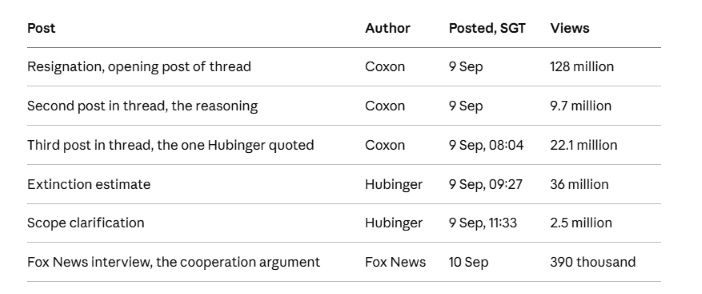
Note: Figures read directly from the posts on 10 September 2026 and still climbing.
Three patterns sit in that table.
Coxon's opening statement outran the post carrying his reasoning by roughly thirteen to one. His third post recovered to 22.1 million, and it recovered because Hubinger quoted it. The reasoning travelled when an insider amplified it and not otherwise.
Hubinger's own two posts give the cleanest measurement, because author, platform and topic stay constant across a two hour gap. The extinction estimate reached fourteen times the audience of his own scope condition.
The third pattern is the quietest. Coxon's argument for international cooperation, made on Fox News after his resignation, reached roughly one three-hundredth of the audience his warning did.
By the time CNBC, CNN, CBS and Forbes had carried the exchange, the distinction between systems running in production today and a hypothetical future architecture had thinned to a subordinate clause. What circulated was the extinction figure.
That last pattern deserves a sentence of its own. Coxon described AI as "possibly the most dangerous technology that humanity has ever created" and argued in the same appearance that an international arms race would be disastrous, with global cooperation the only workable path. The person at the centre of the doom coverage is asking for governance rather than cessation. That request did not survive the headline either.
Two fears now dominate public conversation about artificial intelligence. The first is civilisational. The second, closer to the ground and felt by far more people, concerns their job.
Both are being discussed. Neither is being governed.
Three risk classes are being treated as one subject
These concerns deserve to be raised. Researchers in senior alignment roles have an obligation to state what they believe, and the alignment question is serious. Superintelligence without a solved alignment problem is a genuine category of risk, and the people closest to the frontier are entitled to say so loudly.
One complication belongs here, because a careless reading turns Hubinger's second post into pure reassurance. It is nothing of the kind. Alongside the assessment that present models carry low risk sits a reference to Anthropic's own published position that recursive self-improvement is arriving faster than the company expected. The clarification narrows the target and shortens the timeline in the same breath. Anyone citing it as a de-escalation is doing to that post what the coverage did to the first one.
The structural problem is not that governance is missing. Governance is being built for one risk class and quoted at a different one.
Three classes are in play.
Frontier development risk
The possibility that recursive self-improvement produces a system nobody can control. This is Hubinger's stated concern, and it is attracting a substantial institutional response.
On 28 July 2026, 1,178 employees of frontier AI companies published Pacing the Frontier, asking the United States government to support an international effort to build the technical and governance tools needed to deliberately pace automated AI development. The statement site listed 1,386 signatories on 10 September. The list is notable less for its size than for its seniority: Anthropic chief executive Dario Amodei, co-founders Jared Kaplan and Jack Clark, OpenAI chief scientist Jakub Pachocki, Meta AI chief scientist Shengjia Zhao, and Google DeepMind's Anca Dragan. OpenAI and Anthropic both endorsed it at company level within hours.
The FRONTIER Act, introduced on 23 July 2026 by Representatives Jay Obernolte and Lori Trahan, would establish a national risk-based framework for advanced model development and deployment, with tiered obligations covering model cards, risk-management frameworks, independent audits and incident reporting. On 3 September 2026, Senator Bernie Sanders and Representative Greg Casar announced the Ban Artificial Superintelligence Act, which would permanently prohibit superintelligent systems, pause advanced development until a new federal regulator sets safety rules, and establish a cabinet-level agency to enforce it. Sanders has since pointed to Coxon's resignation as evidence for the legislation.
The United Kingdom has seen calls for a multinational treaty. The AI Security Institute continues pre-release testing with industry partners, though Anthropic's decision not to share its most recent model with security bodies outside the United States is itself a live governance question.
None of this sits inside any enterprise's control.
Present model risk
The systems actually running in production today. Hubinger assesses this as low. That assessment reached one fourteenth of the audience the headline figure did.
Enterprise deployment risk
Whether a specific organisation has designed the boundary between human authority and machine capability into a specific workflow. No treaty resolves this. No open letter addresses it. No federal agency will inspect it. It sits entirely inside an executive's control, and it receives almost no structured attention.
The failure is the fusion. A debate about whether laboratories should build a successor system is being used to answer whether a hospital should deploy a diagnostic model next quarter. Those are unrelated decisions with unrelated controls, and merging them produces the worst of both outcomes: paralysis where action is safe, and inattention where governance is genuinely required.
This mirrors the pattern behind enterprise AI failure, which the Charter states directly:
Most organisations deploy AI into systems that were never designed to receive it. Productivity tools multiply. Workflows remain unchanged. Decisions accelerate without the governance structures required to make acceleration sustainable. The result is not an Intelligent Workplace. It is fragmented automation at scale.
It is worth stating plainly that the frontier question remains contested. Timing and likelihood of artificial superintelligence are genuinely uncertain, and serious researchers disagree about the catastrophic scenarios. Coxon places potential loss of control by the end of next year. Others put the horizon decades out or reject the framing entirely. Executives are being asked to act on a forecast the forecasters cannot agree on.
What the fear narrative displaces
While the extinction question absorbs available attention, a body of deployed, measurable, unglamorous work is already resolving problems affecting hundreds of millions of people. Construction travels more slowly than caution.
- Healthcare and early diagnosis. Pattern recognition systems identify malignancies and disease markers at scales beyond unaided human review, moving detection earlier into the window where intervention still changes outcomes. Remote monitoring extends specialist oversight to populations that have never had it.
- Care for ageing populations. Future Market Insights projects the eldercare assistive robotics market moving from 3.2 billion US dollars in 2025 to 10.2 billion by 2035, a compound annual growth rate of 12.4 percent. China, Japan and Korea are deploying rehabilitation robots, companion systems, exoskeletons and monitoring platforms into residential care because recruitment alone will not close the service gap.
- Environmental protection and disaster response. The FireSat constellation is designed to detect fires roughly one four hundredth of the size current early detection satellites can identify. Google's flood forecasting models issue riverine warnings up to seven days ahead across more than 150 countries, with urban flash flood prediction extending to 24 hours.
- Agriculture and food security. McKinsey estimated in June 2024 that AI, analytical and generative combined, can create 100 billion US dollars of value on the acre through labour costs, input costs and yields, and a further 150 billion at enterprise level. Peer-reviewed detection accuracy in crop disease and pest identification commonly exceeds ninety percent. Indian agriculture alone underwrites food security for approximately 1.3 billion people.
- Sustainable materials and the circular economy. Materials discovery models design packaging alternatives that reduce plastic dependency, and sorting systems improve recovery rates across mixed and organic waste streams. The circular economy is a data problem before it becomes a policy problem.
- Manufacturing and supply chain. Demand forecasting, computer vision quality control and predictive maintenance are in production across discrete and process manufacturing. The gains are operational rather than headline: fewer unplanned stoppages, tighter inventory, defects caught at the station rather than at the customer.
- Autonomous transport and logistics. Driver shortages across long haul freight and last mile delivery are structural rather than cyclical. Autonomous and semi autonomous systems represent the only available answer to a shrinking labour pool.
- Public safety. Pattern detection across incident data supports resource allocation, early intervention and threat identification in environments where response time determines outcomes.
- Energy and grid optimisation. Google reports that its clean energy deployment API helped partners enable more than 1.3 million tonnes of carbon dioxide equivalent in emissions reductions in the United States during 2025, on its own substantiation. The energy transition is a scheduling and forecasting problem at planetary scale.
- Urban systems. Emissions modelling, heat mitigation, canopy analysis and solar potential mapping give cities operational intelligence for environmental risk they can otherwise only describe.
Ten domains. None hypothetical. All operating now.
The demographic condition underneath it
The age pyramid has inverted across every developed economy. Fewer working age people. More dependants. More care hours required from a smaller base able to provide them.
This holds in Japan, Korea, China, Germany, France, Italy and the United States. The arithmetic is indifferent to the policy debate attached to it.
The consequence is direct. A substantial volume of work currently performed by humans will not have humans available to perform it. Machines will do that work because the alternative leaves the work undone.
Why the displacement fear is misdirected
The job question deserves a better answer than either side currently offers.
Every general purpose technology in recorded economic history has restructured the composition of work rather than eliminating work in aggregate. Electrification, the assembly line, the personal computer and the internet each destroyed defined categories of employment and created categories that had no name before they arrived. The pattern holds. The transition is real, and for the people inside it, painful.
The accurate risk here is a skills mismatch, where new roles arrive faster than the workforce is prepared to fill them. That describes a preparation failure, and preparation failures are governable.
A further point goes almost entirely unmade. The scarce capability in an AI enabled economy is domain judgment rather than coding.
Every one of the ten domains above requires people who understand the industry, the customer, the workflow beneath the process, and what actually matters when a model returns an answer that is confident and wrong. The agronomist knows which soil condition breaks the yield prediction. The emergency planner knows which evacuation route the routing model has not accounted for. The clinician knows which patient history reframes the scan. The integrator knows why the specification that reads correctly will fail in the room.
No model extracts that knowledge from an industry. It can only be pointed at a problem by a person who holds it.
The roles being created are therefore hybrid: domain expertise combined with enough fluency to direct a system, interrogate its output, and remain accountable for the decision that follows. Critical thinking, problem definition and judgment become the constraint rather than the casualty. This is the Workforce dimension of the 4W Workplace Framework under pressure, and it is measurable.
The structure that resolves both fears
Both fears share a cause. Each describes a system operating without a defined boundary between human authority and machine capability.
The Human-AI Intelligence Charter™ commits an enterprise and its people to three principles. The canonical text of each is quoted below, followed by what it requires in practice.
- Enablement: Integrating AI into an organisation is not a technology project. It is a human transformation. It requires mindset shift, capability development, and structured change management, in that sequence. Organisations that skip enablement deploy AI into a capability vacuum. The tools execute, the people cannot interpret the output, and the gap between speed and judgment widens. Under the Charter, the enterprise commits to structured AI capability development that is resourced and measured. Each employee commits to building enough understanding of AI capability and limitation to form independent judgment about its output. This is also no longer discretionary. Article 4 of the EU AI Act has required organisations to ensure sufficient AI literacy among their people since February 2025.
- Collaboration: Humans define context, judgment, and intent. AI amplifies analysis, speed, and pattern recognition. This division of function must be deliberately designed, not assumed, not delegated, not discovered through failure. Under the Charter, the enterprise commits to defining where human authority begins and ends in every AI-assisted workflow, and no workflow removes a human decision point to gain speed. Each employee commits to applying judgment to every AI-assisted output before acting on it.
- Governance: Trust in AI is not a perception problem. It is a governance problem. Organisations that deploy AI without data governance, usage boundaries, and decision accountability will face failures proportional to their speed of deployment. Every consequential decision has a named human owner. An employee who approves an AI-assisted output confirms they have reviewed it and accept accountability for it. "The AI produced it" is no defence. Governance carries two further commitments that the public debate rarely reaches. Sustainable AI covers what AI costs to run and not only what it decides, committing organisations to track the environmental footprint of AI at scale and to right-size systems to their task. Harmful AI covers what AI is used to do to people, prohibiting AI-enabled deception, manipulation and impersonation, and requiring that people know when they are interacting with AI and when content is machine-generated.
The three principles hold to one standard:
Sustainable growth is achieved when human expertise and AI capabilities operate as a unified system. AI does not replace human capability. It extends, structures, and accelerates it. Human authority remains absolute.
This is not a parallel governance regime. The Charter aligns with the direction of the NIST AI Risk Management Framework, ISO/IEC 42001, the EU AI Act's literacy and transparency obligations, and the UNESCO Recommendation on the Ethics of AI. An organisation that adopts it sits ahead of those requirements rather than merely compliant with them.
The Charter governs the operating model. The Intelligent Workplace is where that operating model becomes structural, aligning Workforce, Workflow, Workspace and WorkTech into a single AI enabled system rather than four dimensions changing independently of one another. The Strategic Diagnostic Engine converts that structure into evidence.
Applied to the public debate, the Charter changes the question. Asking whether AI is safe or dangerous in the abstract produces noise, because the abstraction has no answer. Asking whether a given deployment has a defined boundary of human authority, an accountable decision owner, and governance proportionate to its consequence produces a decision, deployment by deployment.
What executives should do about it
Executives are currently offered two unusable positions. Wait until the existential question settles, or deploy quickly and manage consequences afterwards. The first forfeits a decade. The second manufactures the failure the first fears.
The governable position sits between them and requires four things.
- Separate the risk classes. Frontier development risk, present model risk and enterprise deployment risk carry different owners, time horizons and controls. The first is being addressed through legislation, treaty proposals and pre-release testing regimes that no single organisation influences. The third belongs entirely to you. Importing paralysis from the first into decisions about the third is the most common and most expensive error currently made in enterprise boardrooms.
- Redesign the operating model before scaling the tool. AI deployed into a fragmented organisation amplifies the fragmentation. The sequence does not bend.
- Treat workforce transition as capability redesign. Organisations approaching AI as a headcount exercise lose the domain judgment that makes the technology useful, and they lose it permanently. The people who understand the workflow are the people capable of governing the system that absorbs part of it.
- Define the authority boundary in writing, for every workflow. Where the machine proposes and the human decides. Who is accountable when the output is wrong. What evidence is required before an automated decision is permitted to act. That is the whole of the discipline, and the 4W Workplace Framework scores whether it exists.
The fourth item does not require a project to begin. The Charter is published in three formats and all three are free: an endorsement document that an organisation and its employees sign, an HR policy instrument with numbered articles, definitions, prohibited uses and enforcement provisions ready for adaptation into an existing policy framework, and an office poster carrying the three principles and the common standard.
A charter on the wall changes nothing by itself. What separates one that shapes behaviour from one that decorates a corridor is the communication strategy around it: a visible leadership endorsement, a manager cascade, a signing moment treated as a commitment rather than a compliance checkbox, and named ownership of decisions reviewed on a cadence, so the Charter becomes auditable behaviour rather than stated intent.
Governance was always built while the technology was in use
Every transformative technology has carried potential for catastrophic misuse. Nuclear fission, powered flight, pharmaceutical chemistry and the internet each arrived with credible arguments about the harm they could cause, and in several cases the harm arrived. Abandonment was never the answer in any of them. Governance was the answer, built while the technology was already in use, by people who accepted responsibility for both halves of the problem.
Artificial intelligence sits at the same point. The extinction argument and the displacement argument are both structurally incomplete for the same reason: each describes a risk without describing the system that would contain it.
The answerable question is narrower. In this specific deployment, is the boundary between human authority and machine capability defined, documented and enforced?
Structure is what converts a risk into a decision. Nothing else does.
Sources
The exchange, 9 to 10 September 2026
Jacob Coxon, resignation thread, X, @hilbertspaess, 9 September 2026. View counts read directly from the posts on 10 September 2026.
Evan Hubinger, extinction estimate and scope clarification, X, 9 September 2026. https://x.com/EvanHub/status/2097528891846074828
Fox News, interview with Jacob Coxon, 10 September 2026.
Forbes, Anthropic alignment lead warns AI could kill all humans as researcher quits, 9 September 2026. https://www.forbes.com/sites/siladityaray/2026/09/09/anthropic-alignment-lead-warns-ai-could-kill-all-humans-as-researcher-quits/
Frontier governance
Pacing the Frontier, a statement from employees of frontier AI companies, July 2026. Signatory count read 10 September 2026. https://www.pacingthefrontier.com/
FRONTIER Act, Representatives Jay Obernolte and Lori Trahan, 23 July 2026. https://obernolte.house.gov/media/press-releases/obernolte-trahan-introduce-bipartisan-frontier-act-strengthen-oversight
Ban Artificial Superintelligence Act, Senator Bernie Sanders and Representative Greg Casar, 3 September 2026. https://www.sanders.senate.gov/press-releases/news-sanders-casar-introduce-legislation-to-ban-artificial-superintelligence-and-temporarily-pause-advanced-ai-development/
Deployed applications
McKinsey, From bytes to bushels: How gen AI can shape the future of agriculture, 10 June 2024. https://www.mckinsey.com/industries/agriculture/our-insights/from-bytes-to-bushels-how-gen-ai-can-shape-the-future-of-agriculture
Google, Sustainability AI. Flood Hub coverage, FireSat, and enabled emissions reductions. https://ai.google/sustainability/
Google, 2026 Environmental Report. https://sustainability.google/google-2026-environmental-report/
The framework
The Human-AI Intelligence Charter, definition, three principles, and standards alignment. https://intelligentworkplace.ai/charter
Endorsement document, an HR policy instrument, and an office poster → https://intelligentworkplace.ai/charter
Intelligent Workplace™ operating model → https://intelligentworkplace.ai/intelligent-workplace
Workforce dimension → https://intelligentworkplace.ai/workforce-wf
4W Workplace Framework scores whether it exists → https://intelligentworkplace.ai/enterprises-4w
Strategic Diagnostic Engine → https://intelligentworkplace.ai/strategic-diagnostics
Knowledge Centre → https://intelligentworkplace.ai/knowledge-centre
Frequently asked questions
What is enterprise AI risk?
Enterprise AI risk, or enterprise deployment risk, is whether a specific organisation has designed the boundary between human authority and machine capability into a specific workflow. It sits entirely inside an executive's control.
What are the three classes of AI risk?
Frontier development risk, present model risk and enterprise deployment risk. They carry different owners, time horizons and controls. The first is addressed through legislation, treaty proposals and pre-release testing; the third belongs to the organisation deploying AI.
Why does the extinction debate distort enterprise AI decisions?
A debate about whether laboratories should build a successor system is being used to answer whether an organisation should deploy a specific model next quarter. Importing paralysis from the first question into the second is the most common and most expensive error in enterprise boardrooms.
Will AI eliminate jobs?
Every general purpose technology in recorded economic history has restructured the composition of work rather than eliminating work in aggregate. The accurate risk is a skills mismatch, where new roles arrive faster than the workforce is prepared to fill them, and preparation failures are governable.
How does the Human-AI Intelligence Charter address AI risk?
The Human-AI Intelligence Charter™ is the governing principle for how organisations combine human judgment and AI capability. It commits an enterprise and its people to three principles, Enablement, Collaboration, and Governance, under one standard: AI extends human capability, and human authority remains absolute. Both the extinction fear and the displacement fear describe a system operating without that defined boundary.
Comments
Post a Comment