What Is Enterprise AI Adoption?
Enterprise AI Adoption is AI use that an organisation has operationalised: embedded in a defined unit of work, with defined authority to act, under the organisation's ownership and governance.
Use that has not been operationalised is practice, not adoption. Provision, meaning licences, plans, and policies without sustained use, is neither. The definition exists because the word adoption is currently asked to answer two different questions at once: whether AI has arrived in an organisation, and whether anything has changed because of it. Official statistics answer the first. Leaders need the second.
Within the Intelligent Workplace operating model, Enterprise AI Adoption is read through the Workforce dimension of the 4W Workplace Framework™ and measured by the Workforce AI Adoption Index across three states: Provisioned, Practised, and Operationalised.
Two numbers, one country, one year
Singapore is a useful place to look at this question, because it is one of the most advanced generative AI markets in the world and because its statistical agencies publish more than most. In 2026, two well-founded figures describe the same country. One says that a clear majority of working-age adults use generative AI. The other says that most firms have not adopted it.
Both are accurate. Both come from credible bodies. Both describe the same twelve months. They cannot both be the answer to the same question, and that is the observation this article starts from: the adoption figures organisations rely on are measuring different things under the same word, and the difference is where the operating decisions live.
The pattern is not confined to Singapore. It is visible in the euro area, in the United States, and in every enterprise that has bought seats for a workforce and then tried to explain to its board what the seats achieved. The licences arrived. The dashboards show activity. The answer to "what changed" is still being written.

Adoption is doing two jobs at once
The structural cause is definitional, and it is worth being precise about it, because the definitions in use are not wrong. They are built for a purpose that is not the purpose most leaders bring to them.
Singapore's Ministry of Manpower published its first survey of AI adoption among firms in April 2026, covering 2,560 establishments at a 97.4 per cent response rate. Its definition counts a firm as adopting AI if it has planned or is planning for AI usage, is piloting or testing AI, has AI actively used by employees, or has integrated AI into its processes. On that definition, 28.5 per cent of Singapore firms have adopted AI and 71.5 per cent have not.
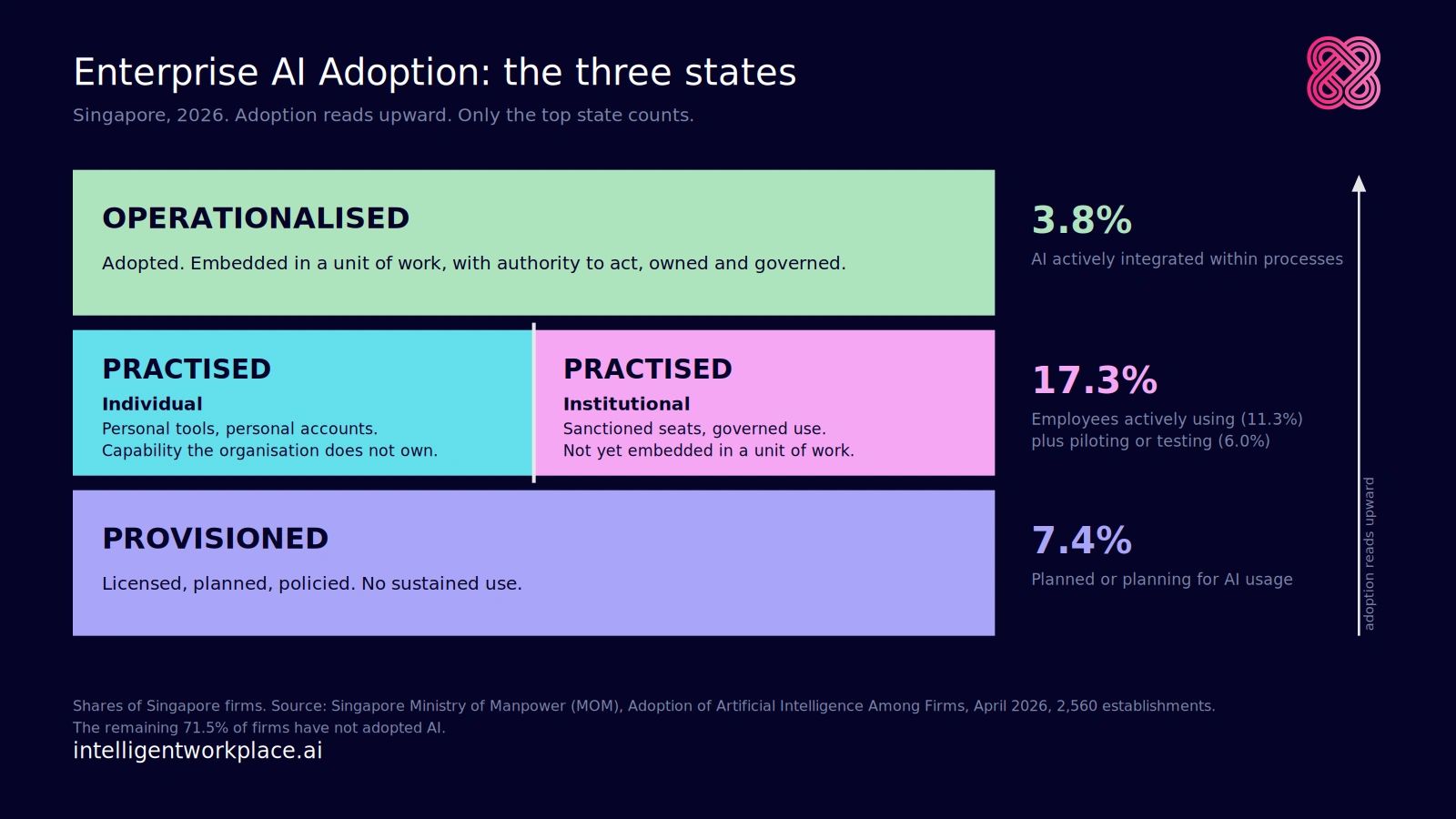
Read by stage, the 28.5 per cent separates into four groups. Firms where AI is actively integrated within processes: 3.8 per cent. Firms piloting or testing: 6.0 per cent. Firms that have planned or are planning: 7.4 per cent. Firms where employees are actively using AI: 11.3 per cent.
Three things are visible once the stages are separated. The largest single component of national adoption is people using AI with no change to any process. A quarter of national adoption is intention. And the only stage in which the organisation itself has changed, integration into processes, is the smallest of the four.
None of this is a criticism of the survey. The Ministry's own report notes that depth of use remains shallow and that most adopters are still at planning or piloting. The definition is deliberately inclusive because its job is to track diffusion: is AI arriving in Singapore's firms, and how fast. For that job, counting a firm that is planning is correct. The firm has crossed from indifference to intent, and that is what a diffusion statistic should capture.
The euro area shows the same shape from a different institution. The European Central Bank's Survey on the Access to Finance of Enterprises, in its round covering late 2025, found that more than seven in ten firms use AI in some form. Of those, a third use it very infrequently or in pilots, a third moderately, and 7 per cent significantly. The ECB's own reading is that simply adopting AI does not guarantee measurable improvement; what matters is what firms use it for, and firms that apply it to core processes report more value than those that confine it to peripheral tasks.
Two official bodies, two regions, two survey designs, and one distribution: broad presence, a thin band of intensive use at the top, and a wide middle where AI is used by people but not yet by the organisation.
Set beside this the population figures. Stanford's 2026 AI Index puts generative AI adoption among Singapore's working-age population at 61 per cent. Microsoft's AI Economy Institute puts it at 60.9 per cent, second in the world. These are person-level measures of use, not establishment-level measures of adoption, and they should never be stacked on the firm figures as if they were rungs of one ladder. They are a separate observation, and a telling one: the people have moved further than the institutions.
The same instability appears at the level of individual technologies. One widely cited quarterly pulse of enterprise agent deployment moved from 42 per cent to 26 per cent to 54 per cent across three consecutive readings, largely because the survey's definition of an agent tightened and then loosened. Nothing in the enterprises changed at that speed. The word did.
And the same gap between reported and tested capability shows up inside the workforce. Section's 2026 AI Proficiency Report found that 54 per cent of knowledge workers rate themselves as proficient with AI while 10 per cent test as proficient, and that fewer than 4 per cent could write workable instructions for a custom assistant when asked to do so. Self-description inflates. Behaviour does not.
The diagnosis, then, is not that the numbers are wrong. It is that adoption, as a word, has been asked to carry a second meaning it was never designed for, and the headline figures are published without the stage breakdowns that would let a leader tell the two meanings apart.
What the official definitions are for
Diffusion statistics exist to answer a national question: is a technology spreading, at what rate, and where is it lagging. Inclusive definitions serve that purpose well. They are comparable across years, they are comparable across countries, and they are cheap to collect at scale. The Ministry of Manpower's four stages are, in fact, more informative than most national statistics, because they are published at all.
What they were never designed to answer
A chief executive asking whether the organisation has adopted AI is not asking whether AI has arrived. The licences are on the invoice; arrival is not in doubt. The question is whether any unit of work now runs differently, whether the organisation owns the capability that has developed, and whether the practice would survive the departure of the people who built it. A diffusion statistic cannot answer that, and it was never meant to.
Three states, one dimension, thirteen functions
The definition at the top of this article resolves the two meanings by naming three states, and by placing the reading where it belongs inside the Intelligent Workplace operating model.
The three states, and where the official numbers sit in them
Provisioned: AI is licensed, planned, or policied, with no sustained use. In the Ministry of Manpower's stages, this is the 7.4 per cent that have planned or are planning. In an enterprise, it is the seats that were assigned and never activated, and the governance document that describes intent but is not enforced anywhere.
Practised: AI is used, and used repeatedly, by people, but it is not embedded in a defined unit of work with defined authority. This is the 11.3 per cent of firms where employees are actively using AI, and most of the 6.0 per cent that are piloting. It is also where the 61 per cent of the population sits. Practised is the largest state in every dataset examined, and it is the state that official definitions fold into adoption.
Operationalised: AI is embedded in a workflow, a process, or an operating model, with granted authority to act, owned and governed by the organisation. This is the 3.8 per cent with AI actively integrated within processes, and the ECB's 7 per cent of significant users. It is adoption in the strict sense of this definition. It is the only state in which the organisation, rather than the individual, has changed.
The states read upward. Provision does not become practice until someone uses the tool; practice does not become adoption until the organisation embeds, authorises, and owns it. Most of what is reported as adoption is the middle state.
Individual or Institutional: the split no survey asks
Inside the Practised state sits a distinction that no national survey collects and that determines what an organisation actually holds.
Practice is Individual when it runs on personal tools, personal accounts, and personal methods: capability that a person built and will take with them. It is Institutional when it runs on sanctioned seats, under governed conditions, in ways the organisation can see and keep.
The distinction matters because the two look identical in a usage statistic and behave completely differently in an organisation. Individual practice is where capability is usually discovered first, because the people closest to the work find the uses before the institution sanctions them. Institutional practice is where capability becomes durable, because it survives handover. An organisation with heavy Individual practice and little Institutional practice is more capable than its adoption figure suggests and owns less of that capability than it believes. Section's data suggests how common that condition is: roughly a third of knowledge workers pay for AI tools themselves, and a similar share use AI at organisations that prohibit it.
Two points of precision, because this is where the definition is most often misread. Individual practice is not adoption; by this definition it is practice, and a security leader who declines to count it as adoption is applying the definition correctly. And the institutional path is not obliged to be as permissive as the personal one; a deliberate decision to cap what sanctioned tools may do is a governance choice, not an institutional failure. The failure is the undeliberate cap: a sanctioned path that costs so much capability that the people who have it decline to take it, and nobody decided that this should be so.
Function by function: the reading no survey can produce
An organisation does not have one adoption level. It has a distribution, and the distribution is by function. Sales, marketing, finance, legal, engineering, facilities, and the executive team each sit in a different state, with different ownership, for different reasons.
The Workforce AI Adoption Index reads adoption by state and by ownership across thirteen functions: Sales; Business Development and Partnerships; Marketing; Customer Success and Support; Product and Engineering; Information Technology and Infrastructure; Finance and Accounting; Human Resources; Legal and Compliance; Supply Chain and Logistics; Facilities and Workplace Operations; Operations; and Executive Leadership.
For each, it establishes the share of people in each state, the split of practice between Individual and Institutional, and two enablement signals: how many people in the function have already connected AI to another system or set it to run on a trigger, and whether the function has an informal person colleagues already turn to.
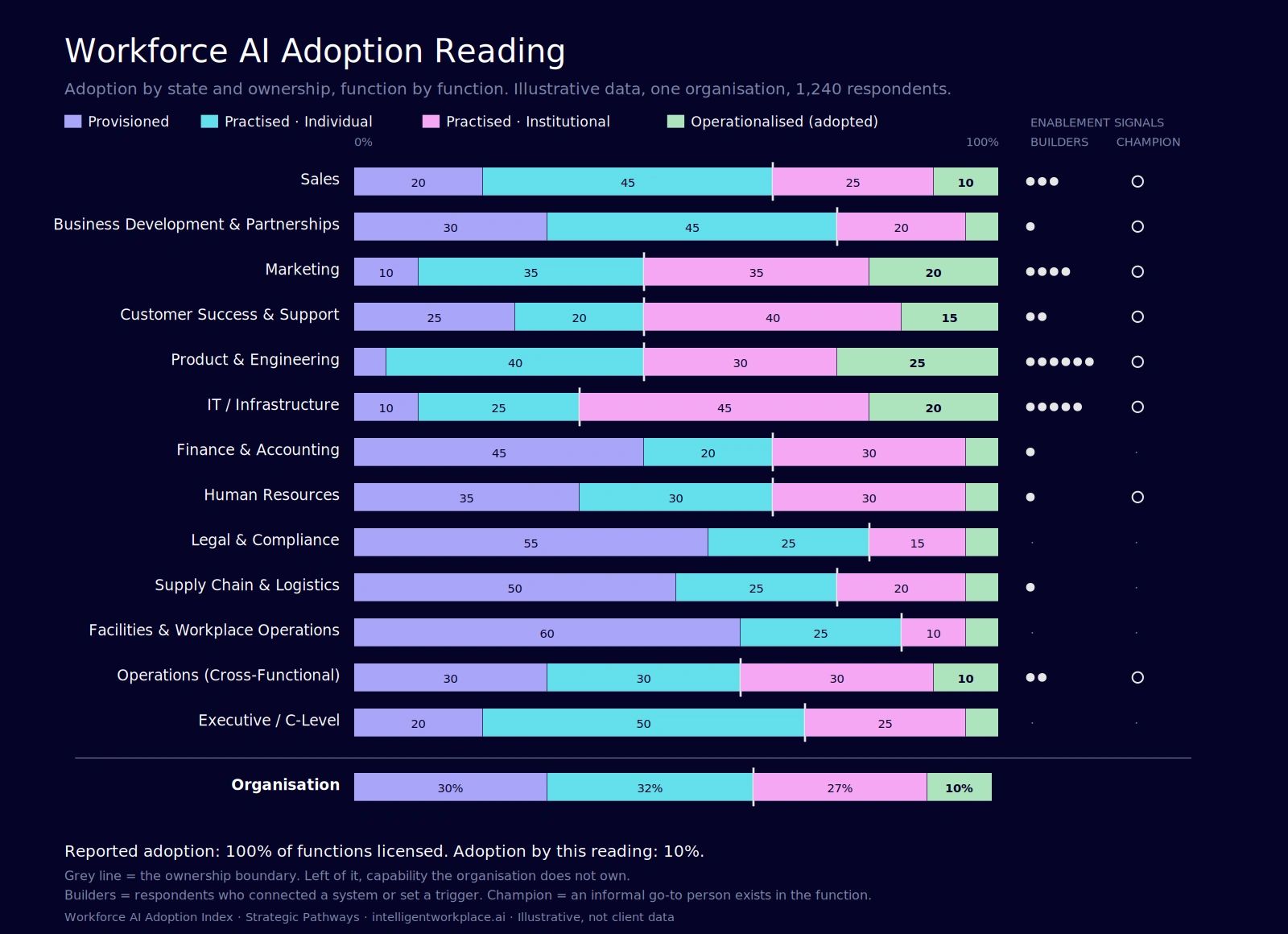
The Index has one evidence rule, inherited from the Strategic Diagnostic Engine: no artefact, no state. A function is Operationalised when it can name the workflow, its trigger, its owner, and what the AI is permitted to do in it. A person is Practised at the Institutional level when the seat and the use are visible to the organisation. Self-description places nobody anywhere.
This is the reading no statistical office can produce, because it requires access to the organisation's systems and knowledge of what each function's work actually consists of. It is also the reading that turns a national headline into an operating decision.
Where the reading sits in the operating model
The Intelligent Workplace aligns four structural dimensions, Workforce, Workflow, Workspace, and WorkTech, into one system, and the Strategic Diagnostic Engine scores an organisation across all four on a five-stage maturity ladder. The Workforce AI Adoption Index is the evidence instrument beneath the Workforce dimension. It does not compete with the 4W Workplace Framework assessment; it feeds it, supplying the function-level evidence behind a Workforce score.
Its boundary is deliberate. The Operationalised state is the top of the Workforce reading and the handoff to Workflow: adoption of AI by the workforce ends where the use is embedded in a governed workflow, and what happens to that workflow afterwards, its automation maturity, its decision rights, its orchestration quality, is the Workflow dimension's question.
Literacy and fluency sit outside the definition, as readiness. They are the preconditions for practice, they are measured well by existing instruments, and in Singapore they are the explicit object of national programmes: the AI Aware, AI Literate, and AI Fluent archetypes, and the SkillsFuture self-diagnostic that assesses readiness against them. Those programmes take a workforce to Fluent. This reading begins where Fluent ends.
What to ask before believing your own adoption number
For the chief executive officer: which state is our adoption figure describing? If the answer is the number of seats, it is Provisioned. If it is the number of people who used the tool this month, it is Practised. Adoption in the strict sense is the number of functions in which a named unit of work now runs with AI inside it, with authority and an owner. Most organisations have never counted that number and would be surprised by it.
For the chief human resources officer: how much of our practice is Individual, and in which functions? That is where the organisation's real capability sits, and it is not on the licence report. The enablement question follows directly. Generic AI literacy programmes lift everyone a little. Identifying the people who have already built something, usually on their own account, and giving them the mandate and the sanctioned infrastructure to build for their colleagues, lifts the function.
For the chief information officer: does the sanctioned path cost capability? If the tools the organisation provides can do less than the tools its people already use, the people will not move, and the organisation will keep reporting Institutional adoption it does not have. The security industry's own guidance on shadow AI has converged on the same point: the effective response is a sanctioned alternative that is good enough to be chosen, not a prohibition that pushes practice onto personal devices.
For the chief financial officer: what share of what we provisioned has never become practice? This is the cheapest number in the reading and the one that most directly changes the next licence negotiation.
For the function leader: where does my function sit, and what would move it one state? The move from Provisioned to Practised is a worked example in the function's own work and permission to spend time on it. The move from Practised to Operationalised is one named workflow, with a trigger, an owner, and a decision about what the AI is allowed to do.
Beneath all five questions sits a governance principle. The Human-AI Intelligence Charter names Governance as one of its three canonical principles, and this reading makes the reason concrete: adoption is a governance state before it is a technology state. An organisation that has not decided what AI may do, in which unit of work, under whose ownership, has not adopted it, whatever the licence count says.
One further point, because it is a blind spot in every survey examined. None of them looks at the environment in which the work happens. Whether the meeting room, the shared space, or the digital workspace has any intelligence in it is not a question any adoption statistic asks. The Intelligent Workplace treats Workspace as a structural dimension in its own right, and a reading of adoption that never enters the room is incomplete in a way that becomes obvious the moment a distributed team tries to work.
Report the shape, not the headline
The proposal this article makes is a reporting one, and it is constructive rather than adversarial, because the bodies that publish adoption figures already hold most of what is needed.
Report adoption by state, not by presence. The Ministry of Manpower already collects four stages; publishing them beside the headline, rather than beneath it, would change how the headline is read without changing a single number. The ECB already distinguishes intensive from occasional use. The stage is the finding.
Read practice by ownership. This is the layer national statistics cannot collect and organisations must collect for themselves, because it determines whether the capability that has developed belongs to the institution or to the individuals who will one day leave it.
Read adoption by function. An organisation-level figure hides the distribution that matters. A function-level reading, with an evidence rule behind every placement, is the difference between a statistic and a decision.
Organisations that do this will find, almost without exception, three things. Their adoption is smaller than reported. It is more alive than reported, because the practice that never appears in the licence data is real and productive. And it is concentrated in people the organisation has not yet noticed, who are usually building on their own account because the sanctioned path was not good enough to be worth taking.
The numbers are right. The reading is incomplete. The Intelligent Workplace is the operating model in which the reading becomes an operating decision: which functions to embed first, which people to give mandate to, what the sanctioned path must be able to do, and where, in the room and in the workflow, intelligence is meant to live.
Related reading on intelligentworkplace.ai
Sources referenced
Singapore Ministry of Manpower, Adoption of Artificial Intelligence Among Firms, April 2026. European Central Bank, Survey on the Access to Finance of Enterprises, round 37, and ECB Blog, June 2026. Stanford Institute for Human-Centered AI, AI Index 2026. Microsoft AI Economy Institute, AI Diffusion Report, 2026. Section, AI Proficiency Report, 2026. Infocomm Media Development Authority and Ministry of Digital Development and Information, National AI Impact Programme archetypes; SkillsFuture Singapore AI readiness self-diagnostic, 2026.
Frequently asked questions
What is enterprise AI adoption?
Enterprise AI Adoption is AI use that an organisation has operationalised: embedded in a defined unit of work, with defined authority to act, under the organisation's ownership and governance. Use that has not been operationalised is practice; licences, plans and policies without sustained use are provision.
What are the three states of AI adoption?
Provisioned: AI is licensed, planned or policied, with no sustained use. Practised: AI is used repeatedly by people, but not embedded in a defined unit of work with defined authority. Operationalised: AI is embedded in a workflow, process or operating model, with granted authority to act, owned and governed by the organisation.
Why do official AI adoption figures disagree?
The word adoption is asked to answer two questions: whether AI has arrived in an organisation, and whether anything has changed because of it. Singapore's Ministry of Manpower counts planning, piloting, active use and integration as adoption, which gives 28.5 per cent of firms; only 3.8 per cent have AI integrated within processes.
What is the difference between individual and institutional AI practice?
Individual practice runs on personal tools, personal accounts and personal methods, so the capability leaves with the person who built it. Institutional practice runs on sanctioned seats under governed conditions, so the organisation keeps it.
How is enterprise AI adoption measured?
Through the Workforce dimension of the 4W Workplace Framework. The Workforce AI Adoption Index reads adoption by state and by ownership across thirteen functions, under one evidence rule inherited from the Strategic Diagnostic Engine: no artefact, no state.
Comments
Post a Comment