Human-AI Intelligence Charter as a Governance Layer
The Human-AI Intelligence Charter™ is the governing principle for how organisations combine human judgment and AI capability. It commits an enterprise and its people to three principles, Enablement, Collaboration, and Governance, under one standard: AI extends human capability, and human authority remains absolute.
The Human-AI Intelligence Charter is the governing principle that defines how Strategic Pathways designs and governs every framework, product, and engagement.
It exists because organisations are deploying AI into systems that were never designed to receive it. The result is not intelligent work. It is fragmented automation at scale. The Charter closes that gap through three delivery principles, Enablement, Collaboration, and Governance, each with a defined mechanism rather than a value statement.
The Charter sits above every Strategic Pathways framework, product, and AmplifyPath™ family of AI-powered systems. Human authority remains absolute. This is the constant beneath any AI-enabled operating model, regardless of how large the model or the organisation becomes.
Meta Just Published a Manifesto for a Problem It Cannot Solve Alone
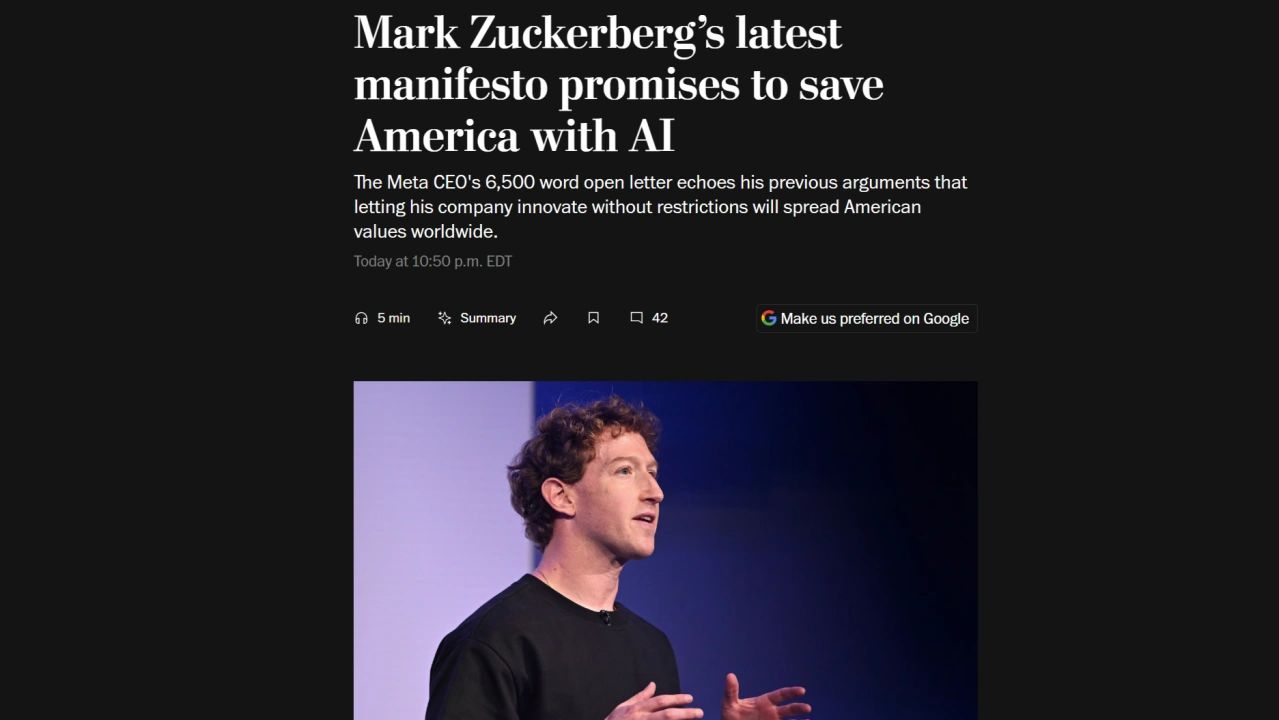
On 10 August 2026, Mark Zuckerberg published a long essay setting out Meta's philosophy for what he calls personal superintelligence. It is a genuine step in the right direction. Its central argument, that intelligence should empower individuals rather than concentrate in a few institutions, and that human authority must remain the check on power as AI scales, is the correct instinct at civilisational scale.
But a manifesto is a statement of intent, not an operating model. It sets direction for a platform used by billions. It does not tell a single enterprise, deploying AI into its own workflows this quarter, where human judgment sits, who is accountable for a given decision, or how its people are meant to develop the capability to work alongside the systems being deployed around them. That is not a criticism of the essay's ambition. It is a description of the gap between philosophy written for a civilisation and infrastructure built for an organisation.
That gap is precisely where the Human-AI Intelligence Charter operates, and it was built to close it before this became a subject for essays from the largest labs in the industry.
Where the Manifesto Stops Short
Three gaps separate a civilisational philosophy from an operating model, and each is where organisations following the spirit of Meta's essay without a governing structure of their own will run into trouble.
No sequencing. Zuckerberg's essay treats capability distribution as the goal itself: get powerful tools into as many hands as possible, as affordably as possible. What it does not address is the order of operations inside an organisation adopting those tools. Capability handed to people who have not gone through a deliberate mindset shift and structured change management does not produce empowerment. It produces a capability vacuum, tools executing work that no one is yet equipped to judge.
No defined division of function. The essay argues that alignment means agents serving a person's goals rather than a company's. That is a sound principle for a consumer product. It is not a mechanism. It does not specify, for a given workflow inside a business, where human judgment begins and where AI's analysis and pattern recognition end. Without that division being deliberately designed, it is assumed, and assumption is how fragmentation enters at exactly the point capability is scaling fastest.
No decision accountability. Zuckerberg's argument for safety rests on aggregate trust: once billions of people are using and scrutinising personal agents, alignment to individual interests will, in effect, have been solved by the scale of adoption itself. That may hold at platform scale over time. It offers nothing to a CEO who needs to know, this quarter, who is accountable when an AI-assisted decision goes wrong inside their organisation. Capability outpaces governance by default. Tools multiply, workflows stay the same, and decisions accelerate before the accountability structures that would make that acceleration safe have caught up.
These are not flaws in Meta's ambition. They are the natural limits of a document written for a civilisation rather than a company. As Zuckerberg himself frames the underlying risk, "there is no such thing as a singular benevolent superintelligence." By the same logic, there is no single manifesto, however well-intentioned, that operationalises itself inside an organisation without a governing structure to carry it.
The Charter as the Governance Layer That Was Already Built
The Human-AI Intelligence Charter operationalises the same structural answer at the scale of an organisation and an engagement, rather than at the scale of a civilisation.
Enablement. The integration of AI into an organisation is not a technology project. It is a human transformation, requiring mindset shift, capability development, and structured change management, in that sequence. Skip enablement and AI is deployed into a capability vacuum: the tools execute, the people do not understand the output, and the gap between speed and judgment widens.
Collaboration. Humans define context, judgment, and intent. AI amplifies analysis, speed, and pattern recognition. This division of function must be deliberately designed, not assumed, not delegated, and not discovered through failure. Every workflow that involves AI must specify where human authority begins and ends.
Governance. Trust in AI is not a perception problem. It is a governance problem. Organisations that deploy AI without data governance, usage boundaries, and decision accountability will face failures proportional to their speed of deployment.
Every AmplifyPath™ system Strategic Pathways operates, and every engagement it delivers, runs to the same standard: structured intelligence precedes execution, human authority governs every decision, and AI extends capability without replacing judgment.
What Zuckerberg's essay argues is necessary at the level of global AI policy, the Charter has already made operational at the level of the organisation. That is the distinction worth naming plainly. The Charter was never a values statement produced for a website. It is the governance mechanism that determines whether AI adoption compounds an organisation's capability or compounds its fragmentation
What This Means for Executives Deploying AI Today
Most leaders reading a philosophy piece from a major lab treat it as a signal about where the technology is heading. The more useful reading is structural. It confirms what kind of organisational problem AI adoption actually is, and it confirms that the answer is not a better model. It is a governance layer that was designed before the deployment started, not retrofitted after.
For an executive currently overseeing AI adoption, three implications follow directly.
First, do not wait for external governance standards to arrive before establishing internal ones. The organisations already operating a Charter-equivalent structure will not be retrofitting alignment when the rest of the market catches up. They will already be operating it.
Second, treat AI deployment and AI-enabled operating models as two different undertakings. Deploying a tool is not the same as designing where human judgment sits relative to that tool. The first produces automation. The second produces an intelligent operating model. Most organisations are still doing only the first.
Third, audit for the exact failure pattern Zuckerberg's essay and the Charter both name from different directions: capability without accountability. Wherever an AI system is producing outputs that no defined human role is required to review, challenge, or approve, that is the concentration risk showing up inside a single workflow rather than a single company.
Why governance is the same question at every scale
The debate about how to govern powerful AI is usually framed as something happening above the level of any individual organisation, a matter for labs, regulators, and policy. Zuckerberg's essay reinforces the opposite conclusion. The governance question is structurally identical at every scale it appears, from a single workflow to a global platform. The organisations that will navigate this well are not the ones waiting for the answer to be settled elsewhere. They are the ones that have already built the structure that settles it internally.
As Marc A. Rémond puts it: "I have built it at the scale of one. The principles do not change at the scale of a thousand."
The Human-AI Intelligence Charter was never a philosophy statement. It was infrastructure, built for exactly the moment the rest of the market is now beginning to describe.
Explore more:
Frequently asked questions
What is the Human-AI Intelligence Charter?
The Human-AI Intelligence Charter™ is the governing principle for how organisations combine human judgment and AI capability. It commits an enterprise and its people to three principles, Enablement, Collaboration, and Governance, under one standard: AI extends human capability, and human authority remains absolute.
How does the Charter relate to Meta's personal superintelligence essay?
On 10 August 2026, Mark Zuckerberg argued that intelligence should empower individuals and that human authority must remain the check on power as AI scales. The Charter operationalises the same structural answer at the scale of an organisation rather than a civilisation.
Where does a manifesto stop short of an operating model?
In three places: no sequencing of how capability is introduced, no defined division of function between human judgment and AI, and no decision accountability for when an AI-assisted decision goes wrong.
What should executives deploying AI do now?
Establish internal governance before external standards arrive; treat AI deployment and AI-enabled operating models as two different undertakings; and audit for capability without accountability, wherever AI output has no defined human role required to review, challenge or approve it.
Comments
Post a Comment