Gartner and the Operating-Model-First Approach to AI
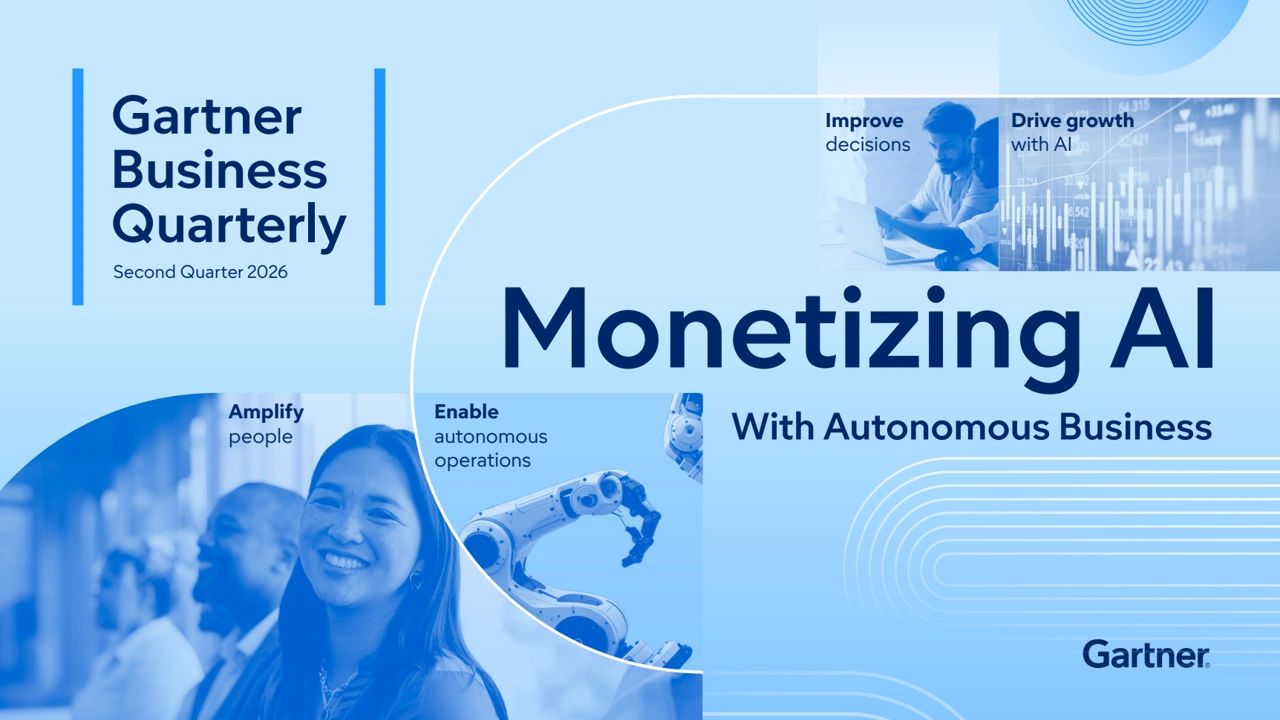
Gartner's argument that autonomous business is how AI will be monetised rests on the same principle as the Intelligent Workplace: the operating model must precede the technology. Autonomous systems layered onto a misaligned organisation do not produce coherent outcomes.
The Intelligent Workplace as a Foundation for Autonomous Business
The Intelligent Workplace™ is an enterprise operating model that aligns four structural dimensions (Workforce, Workflow, Workspace, and WorkTech) into a unified, AI-enabled system. It is not a technology initiative. It is the architectural foundation that determines whether AI investments produce returns or simply produce more complexity.
Gartner's second quarter 2026 Business Quarterly edition makes a consequential claim: autonomous business is the strategy through which AI will be monetised. Their argument deserves attention - not because it introduces a new concept, but because it validates what every serious transformation leader already knows.
Why Enterprise AI Has Not Delivered Returns
Gartner is direct about the failure pattern. Boards and CEOs gave their organisations patience and budget to explore AI use cases. What they received was learning, not returns. The investments have been real. The business outcomes have not matched expectations.
The diagnosis is structural. Organisations chased capability without architecture. Tools were deployed into workflows that were never redesigned to accommodate them. Speed was added without governance. The result was not intelligent work. It was fragmented automation.
This is the same problem the Intelligent Workplace™ framework was designed to address. Fragmented technology investment - without a unifying operating model - does not produce transformation. It produces noise at scale.
The Operating Model Must Precede the Technology
Gartner's autonomous business framework rests on a principle that maps directly to the 4W Workplace Framework: you cannot layer autonomous systems onto a misaligned organisation and expect coherent outcomes.
Their five components of autonomous business - autonomous operations, augmented workforce, autoadapting products, machine customers, and programmable economy - each require structural readiness before deployment. Autonomous operations require redesigned workflows. An augmented workforce requires a Workforce dimension that has been reconfigured for Human-AI collaboration. Governance must be established before machines gain agency, not after.
This sequence is not a preference. It is a requirement. The operating model precedes the technology. The 4W Framework operationalises this sequence: Workforce, Workflow, Workspace, and WorkTech must be assessed and aligned before transformation investment is committed.
Why governance enables autonomous business
Gartner issues a specific caution to C-suite leaders: put governance first. As machines gain greater agency, the guardrails that keep decisions aligned with enterprise values and regulatory requirements are not optional features. They are the condition under which autonomous systems can be trusted.
The Human-AI Intelligence Charter™ exists precisely for this reason. Its three principles (Enablement, Collaboration, Governance) define how organisations design the relationship between human judgment and machine capability. Enablement ensures humans are equipped for the transition. Collaboration defines where human and machine authority meet. Governance determines how intelligence is kept aligned and accountable.
Deploying AI without this framework is, as the analysis makes clear, deploying fragmentation at scale.
Architecture before ambition
Gartner notes that only 44% of CEOs consider their own CIOs AI savvy. The gap is not primarily technical. It is architectural. Leaders who cannot describe how their operating model changes, not just which tools they are deploying, are not ready for autonomous business.
The transition Gartner describes is not incremental. It is a fundamental shift in how organisations create and distribute value. Digital business changed what organisations do. Autonomous business changes how they do it.
The Intelligent Workplace™ is the operating model through which that shift becomes executable. Not a project. Not a programme. An architecture that aligns the four dimensions of work before autonomous capability is layered in.
Structure first, technology second
The organisations that will lead autonomous business are not the ones with the most sophisticated tools. They are the ones with the clearest operating model. The Intelligent Workplace provides that model, diagnosed through the 4W Workplace Framework. The Human-AI Intelligence Charter™ provides the governance layer. The Strategic Diagnostic Engine identifies where alignment gaps sit before transformation investment is committed.
The Gartner thesis and the Intelligent Workplace architecture point to the same conclusion: structure first, technology second. The sequence is the strategy.
To learn more, visit:
- The Intelligent Workplace
- The 4W Workplace Framework
- The Human-AI Intelligence Charter
- The Strategic Diagnostic Engine
Frequently asked questions
What does Gartner mean by autonomous business?
In its second quarter 2026 Business Quarterly, Gartner argues that autonomous business is the strategy through which AI will be monetised, built on five components: autonomous operations, augmented workforce, autoadapting products, machine customers and programmable economy.
Why has enterprise AI not delivered returns?
Organisations chased capability without architecture. Tools were deployed into workflows never redesigned to accommodate them, and speed was added without governance. Boards gave patience and budget, and received learning rather than returns.
Why must the operating model precede the technology?
Each component of autonomous business requires structural readiness before deployment: autonomous operations need redesigned workflows, and an augmented workforce needs a Workforce dimension reconfigured for human-AI collaboration.
What role does governance play in autonomous business?
Governance comes first. As machines gain agency, the guardrails that keep decisions aligned with enterprise values and regulation are the condition under which autonomous systems can be trusted. The Human-AI Intelligence Charter defines that relationship through Enablement, Collaboration and Governance.
Comments
Post a Comment