Why AI Returns Depend on Process Redesign Before Tools
AI returns depend on process redesign because AI deployed into workflows built for human execution speeds up individual steps while the overall architecture stays unchanged. Redesigning the workflow around what AI does differently comes before choosing the tool.
Why AI Investment Is Failing To Move Business Metrics
Organisations worldwide are experiencing a fundamental disconnect between AI investment and business impact. Companies implement sophisticated AI systems with impressive technical specifications yet see minimal improvement in actual performance metrics. A manufacturing firm invests six months in AI-powered quality control, achieves exceptional accuracy rates, but defect rates remain unchanged. Financial institutions deploy machine learning algorithms for risk assessment while maintaining the same lengthy approval processes that create customer friction.
This pattern repeats across industries: heavy technology investment, technical implementation success, and negligible business outcome improvement. The disconnect is not technological but architectural. Organisations are adding AI capabilities to existing workflows rather than redesigning workflows around AI possibilities.
Workflow Architecture: The Real Bottleneck Behind AI Underperformance
The root cause of AI underperformance is workflow architecture. Organisations inherit process structures built for human execution speeds and human decision-making patterns. These legacy architectures contain three critical constraints that limit AI impact: sequential dependencies that prevent parallel processing, decision bottlenecks that require human approval for routine determinations, and information silos that limit data availability for AI systems.
When AI is deployed within these constraints, it optimises individual steps while leaving the overall architecture inefficient. The AI speeds up one node in a network designed for slow throughput. Genuine transformation requires architectural redesign, rebuilding workflows to exploit what AI does differently from humans.
Process-Native AI: The Revolution Beyond Tooling
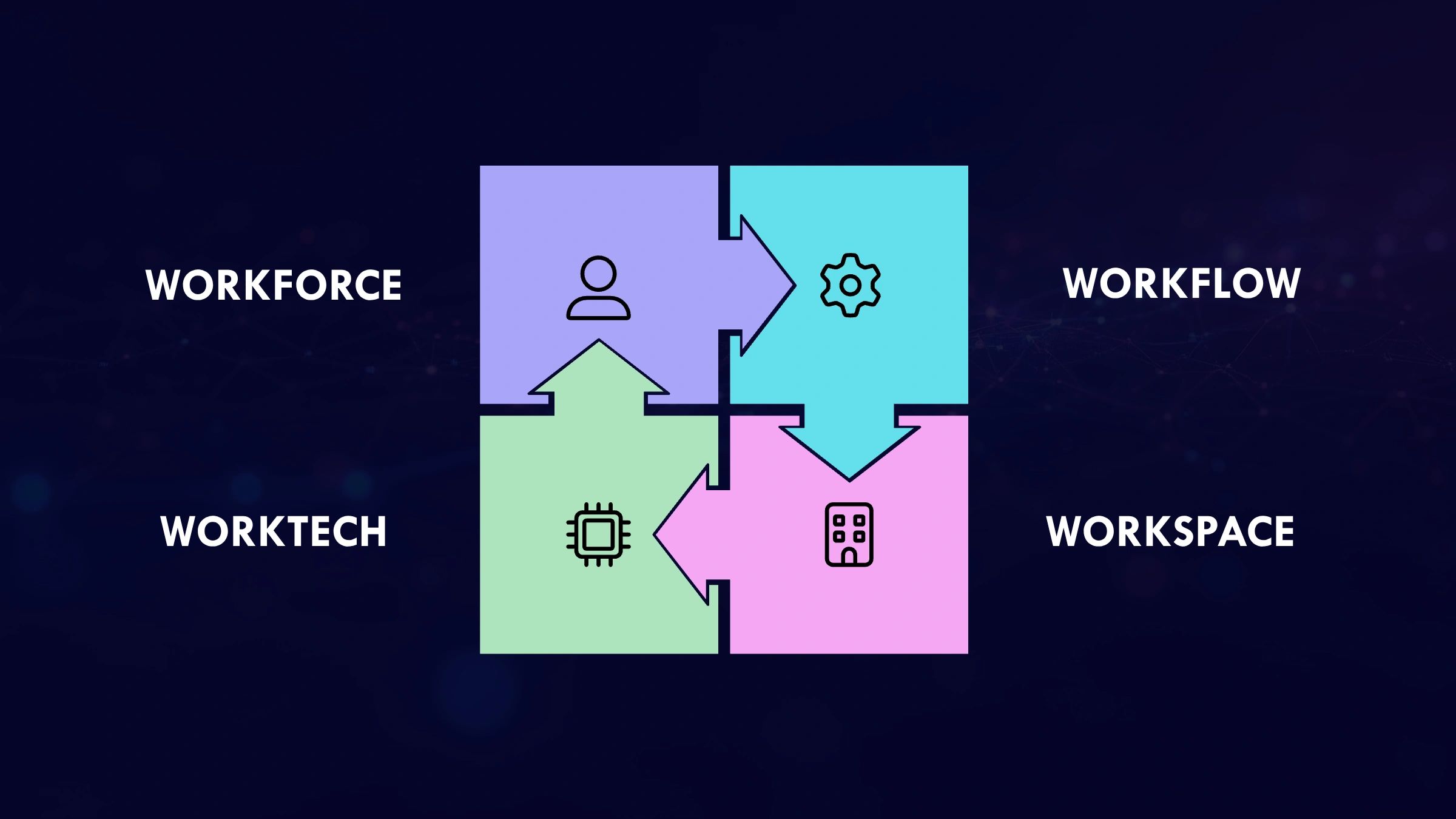
The 4W Workplace Framework diagnoses process transformation across its four dimensions: Workflow, Workforce, WorkTech and Workspace.
Workflow, how work is designed and executed, begins with outcome mapping: defining what the process must achieve, then building backwards to determine optimal Human-AI task allocation. Activities requiring contextual judgment, ethical assessment, or relationship management remain with humans. Activities requiring data processing, pattern recognition, or routine decision-making migrate to AI systems. The result is a hybrid workflow that exploits the distinct capabilities of both.
Workforce, human capability and Human-AI partnership, addresses the human side of transformation. Process redesign without capability development creates adoption failure. The 4W Workplace Framework mandates parallel investment in process architecture and human capability, ensuring people can operate effectively within new Human-AI structures.
WorkTech, the technology systems that enable intelligence, ensures that AI systems connect across the organisation rather than operating as isolated tools. Integrated AI creates compound value: each system informing and improving others. Siloed AI creates the tool deployment trap, sophisticated individual capabilities with limited organisational impact.
Workspace, physical and digital environments, determines whether the places where work happens support the redesigned process. Across all four dimensions, continuous learning loops let Human-AI collaboration produce insights that improve future performance. The organisation learns from each Human-AI interaction, building institutional intelligence that compounds over time.
Why Process Redesign Must Precede AI Deployment
For executives, the strategic implication is clear: AI ROI is a process design question before it is a technology question. Organisations that approach AI transformation as workflow architecture projects, rather than technology deployment projects, consistently achieve superior outcomes.
This reframing changes the leadership agenda. The critical decisions shift from which AI tools to acquire to how workflows should be restructured to exploit AI capabilities. It elevates process architecture to strategic priority and positions Human-AI integration as a core organisational capability rather than an IT function.
AI Amplifies What It Finds. Fix the Process First.
The organisations succeeding with AI transformation share a common characteristic: they treat AI as a design constraint that reshapes workflows, not a plug-in that enhances them. They ask fundamentally different questions. Not how can AI help us do this faster, but how should we restructure this process now that AI makes certain things possible.
Workflow optimisation produces incremental gains. Workflow reimagination produces category-defining advantages. The AI revolution is not about the tools you deploy. It is about the processes you redesign.
To explore how the 4W Workplace Framework and the Intelligent Workplace diagnostic structure AI-ready process transformation, visit the Intelligent Workplace.
About the Author
Marc A. Rémond is the founder of Strategic Pathways and an architect of business operating models for growth. He is the creator of the Intelligent Workplace™ and its frameworks, the 4W Workplace Framework™, 4D Delivery Framework™, 4C Channel Framework™ and 4P Partner Framework™, together with the Strategic Diagnostic Engine™ and the Human-AI Intelligence Charter. He is the architect of the Synchronised Growth Architecture and the author of EVOLVE-OR-DIE.AI. With more than 25 years in enterprise technology across the Asia Pacific region, he writes on the operating models organisations need to scale in the AI era.
Frequently asked questions
Why do AI investments fail to move business metrics?
Organisations add AI capabilities to existing workflows rather than redesigning workflows around AI. The result is heavy technology investment, technical success and little change in business outcomes.
What limits AI impact inside legacy workflows?
Three constraints: sequential dependencies that prevent parallel processing, decision bottlenecks that require human approval for routine determinations, and information silos that limit the data available to AI systems.
How does the 4W Workplace Framework apply to process redesign?
Workflow redesigns the process around outcomes and Human-AI task allocation; Workforce builds the capability to operate it; WorkTech connects AI systems across the organisation; and Workspace ensures the environments support the new process.
What should executives decide first?
How workflows should be restructured to exploit AI capabilities, before deciding which AI tools to acquire. AI return on investment is a process design question before it is a technology question.
Comments
Post a Comment