What Is the 4W Workplace Framework?
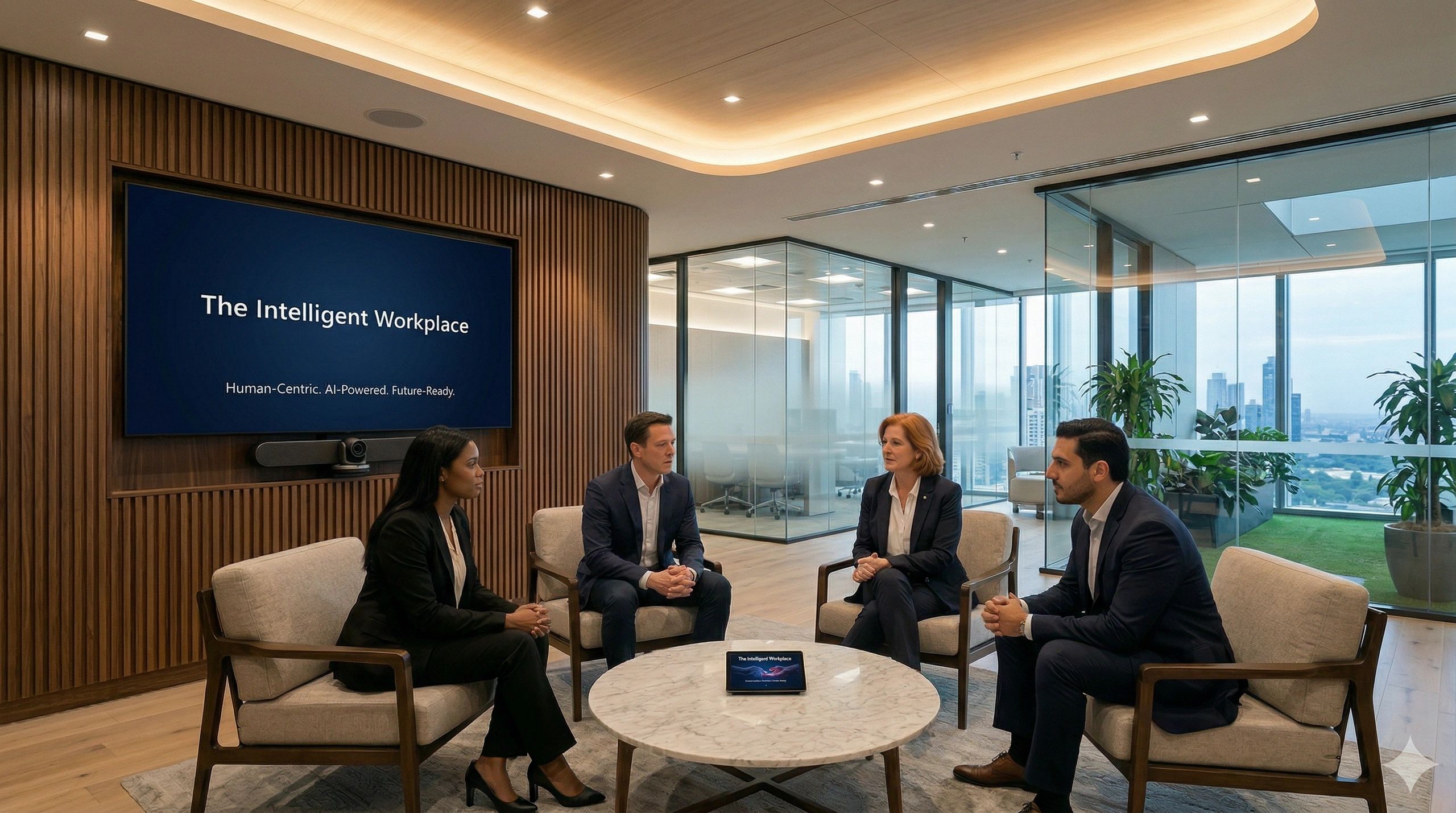
The 4W Workplace Framework is the diagnostic instrument for Intelligent Workplace transformation, aligning four structural dimensions: Workforce, human capability and Human-AI partnership; Workflow, how work is designed and executed; Workspace, physical and digital environments; and WorkTech, the technology systems that enable intelligence. Sustainable workplace performance requires alignment across all four dimensions, not improvement of any single element in isolation.
Why investing in the right levers still disappoints
Most executives believe they are managing workplace performance by investing in the right levers. They hire strong talent, refine their processes, and deploy the latest technology platforms. Yet performance remains frustrating, transformation efforts stall, and AI initiatives fail to deliver the returns the investment promised.
The pattern is consistent across industries and geographies. Leaders are optimising components while the system stays broken.
The missing view of the workplace as a system
The structural problem is not the quality of the individual investments. It is the absence of a diagnostic framework that treats the workplace as an integrated system. When Workforce decisions are made without reference to Workflow design, when WorkTech is deployed without considering Workspace implications, and when no single model connects all four, fragmentation is the inevitable outcome.
Most organisations have never diagnosed their workplace as a system. They have audited individual parts. The parts look reasonable. The system does not perform.
The four dimensions of the 4W Workplace Framework
The 4W Workplace Framework addresses this blind spot by treating four dimensions as an interconnected architecture rather than four independent improvement tracks.
Workforce is the first dimension: human capability and Human-AI partnership. It is not just about hiring skilled people. It is about understanding how those people actually collaborate, where they get stuck, and how Human-AI partnership is changing what capability means. Most leaders know their team's technical skills but have little insight into their collaboration patterns or AI readiness.
Workflow is the second dimension: how work is designed and executed. It goes deeper than process documentation. It is about understanding how decisions really get made, where information flows smoothly or gets bottlenecked, and how work rhythms align with human energy and AI augmentation. Many organisations have beautifully documented processes that bear little resemblance to how work actually happens.
Workspace is the third dimension: physical and digital environments. It extends far beyond office layouts. It encompasses the digital environments where people spend most of their time, the physical spaces that either energise or drain focus, and the design decisions that determine whether people can do their best work. Leaders consistently underestimate how profoundly environment shapes performance.
WorkTech is the fourth dimension: the technology systems that enable intelligence. It is not the number of tools deployed. It is whether those tools form a coherent intelligence architecture, whether they reduce friction or create it, and whether they extend human capability or simply add complexity.
The Intelligent Workplace emerges when all four dimensions are diagnosed and aligned as a system. The Human-AI Intelligence Charter provides the governance model that determines how humans and AI collaborate within that system.
From improving components to aligning a system
The implication for leaders is a fundamental shift in how workplace investment decisions are framed and sequenced. The question is no longer "how do we improve our people, processes, and technology?" It is "how do we align Workforce, Workflow, Workspace, and WorkTech into a system that performs?"
A highly skilled Workforce will underperform in misaligned Workflows. Efficient Workflows will break down without a Workspace designed to support them. And even the best Workspace cannot compensate for a WorkTech layer that fragments rather than enables.
This is why so many AI investments are delivering disappointing returns. The technology is capable. The system it is being dropped into is not aligned to receive it.
The diagnostic question for the AI era
The organisations that will perform in the AI era are not those with the best individual components. They are those that have diagnosed and aligned all four dimensions of the 4W Workplace Framework into a coherent operating architecture.
Reference signals
- Gartner: Digital Workplace Maturity Models; Predicts 2026: Digital Workplace and AI Enablement
- McKinsey Global Institute: Reimagining the Office and Hybrid Work; The State of AI
- Deloitte: Digital Workplace and Human Experience
- Harvard Business Review: Why AI Fails Without Organizational Readiness
- Microsoft: Work Trend Index Reports
The diagnostic question is not whether your organisation has good people, processes, technology, or environments. It is whether your Workforce, Workflow, Workspace, and WorkTech work together as a system, or inadvertently undermine each other.
That is the question the Intelligent Workplace is designed to answer.
Frequently asked questions
What is the 4W Workplace Framework?
The 4W Workplace Framework is the diagnostic instrument for Intelligent Workplace transformation, aligning four structural dimensions: Workforce, human capability and Human-AI partnership; Workflow, how work is designed and executed; Workspace, physical and digital environments; and WorkTech, the technology systems that enable intelligence.
Why do workplace investments disappoint even when each one is sound?
Because there is no diagnostic framework treating the workplace as an integrated system. Workforce decisions are made without reference to Workflow design, WorkTech is deployed without considering Workspace, and no single model holds all four in view.
How is the 4W Workplace Framework different from improving people, processes and technology?
It replaces four independent improvement tracks with one question: how do we align Workforce, Workflow, Workspace and WorkTech into a system that performs?
How does the 4W Workplace Framework relate to the Intelligent Workplace?
The Intelligent Workplace is the enterprise operating model; the 4W Workplace Framework is the instrument that diagnoses how close an organisation is to it and what is constraining the distance.
Comments
Post a Comment